Fast, Reliable Attic Insulation Across Hesperia
Attic insulation in Hesperia has to solve a problem most Southern California homes never face: a 3,200-foot high-desert climate where summer afternoons push past 100°F and winter nights drop below freezing, often within the same week. That means your attic needs to block serious heat gain in August and hold heat in during January, all while standing up to the wind-driven sand that blows through the Cajon Pass. We’re Magnolia Insulation Co, and we’ve spent years diagnosing exactly what goes wrong in Hesperia attics. If your energy bills swing hard between seasons or your rooms never feel consistent, call (866) 464-1714 and we’ll walk the attic with you.
Why Magnolia Insulation Co Is Hesperia’s Preferred Attic Insulation Company
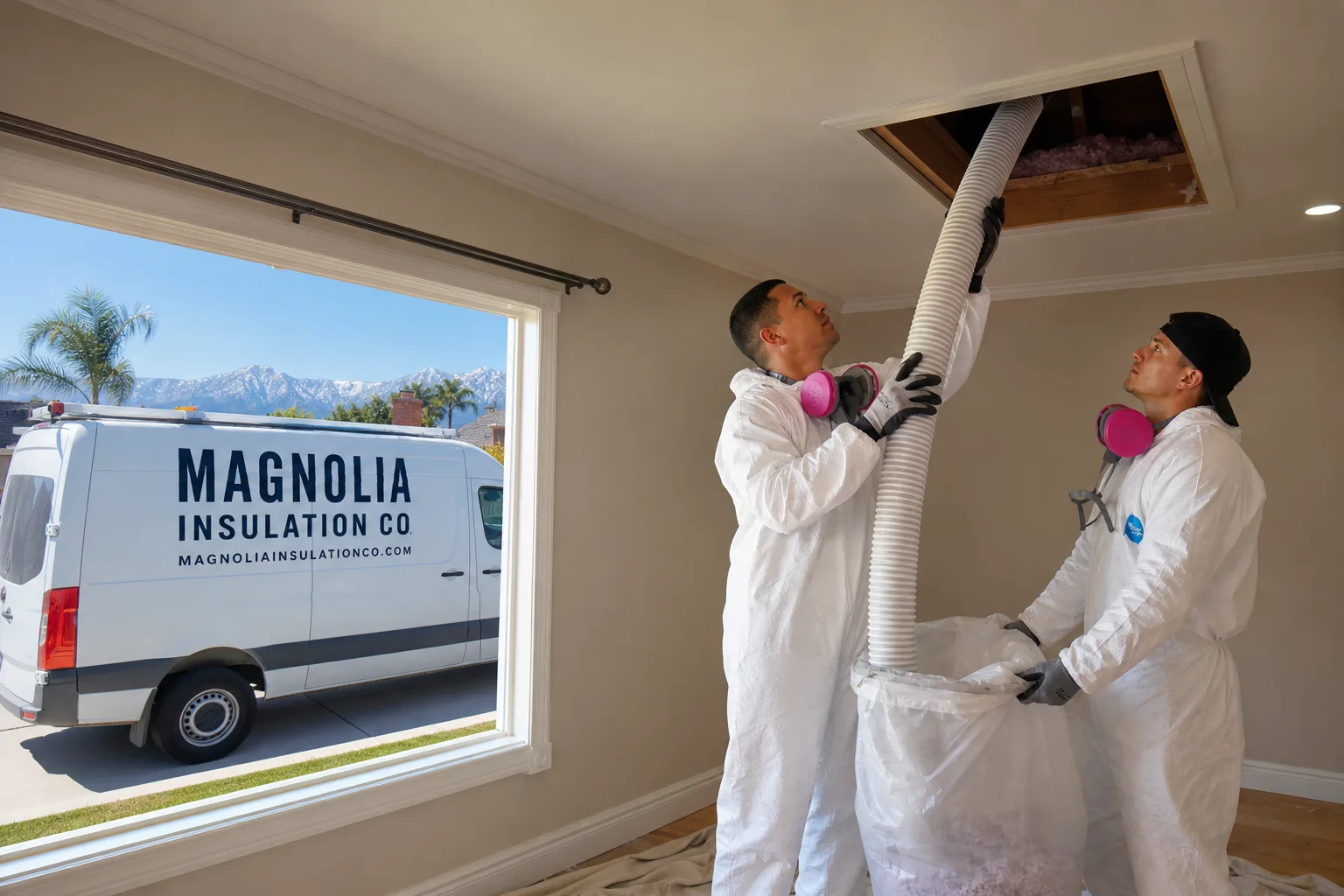
Hesperia homeowners call us because we understand the specific failure patterns of tract homes built between the 1980s and 2000s. Most still carry the original builder-grade R-11 to R-19 batts, which fall far short of what Title 24 requires today. When we pull back those batts in neighborhoods off Bear Valley Road or near Hesperia Lake, we usually find the same thing: wind-deposited sand packed against the north eaves, matted insulation, and soffit vents that haven’t breathed in years. We also know that many Hesperia homes are single-story with low-pitch roofs and tight attic access, which means our crews show up prepared with the right equipment to work efficiently in limited space. Glen Pacheco leads our team with a straightforward approach: diagnose the actual thermal problem, then match the material to the structure. Homeowners in the 92344 and 92345 zip codes reach us fast, and our response time to Hesperia from our Rancho Cucamonga base is typically same-day or next-day for quotes.
Attic Ventilation in Hesperia
Attic Ventilation in Hesperia is not a nice-to-have; it is the first thing we check before quoting any insulation job, because the desert wind funnels fine sand through your vents and packs the north eaves with a dust layer that chokes airflow. Without working eave vents and soffit channels, your attic becomes an oven in July and a condensation trap on cold winter mornings. We start every Hesperia attic evaluation by inspecting and clearing those vents. A full ventilation assessment and repair with new baffles typically runs $220 to $480 depending on attic size and how badly the existing vents are clogged.
Clearing Sand-Packed Eave Vents
Hesperia’s persistent wind pushes sand into vent openings along the north and northwest eaves. We vacuum out the drift, clear the soffit channels, and install baffles that keep insulation from covering the vents again. This single step often drops attic temperatures by 15 to 20 degrees in summer.
Balance Between Intake and Exhaust
Many Hesperia attics were built with minimal venting, and adding insulation without fixing airflow actually makes things worse. We calculate intake-to-exhaust ratios so warm air exits through ridge or roof vents while cooler air enters through the eaves. The goal is a ventilated attic that protects your insulation investment.
Radiant Barrier in Hesperia
Radiant Barrier in Hesperia is one of the highest-impact upgrades you can make in a high-desert climate with relentless summer sun. A radiant barrier is a reflective material installed on the underside of roof rafters that bounces radiant heat back out before it ever reaches your insulation. In Hesperia, where roof deck temperatures routinely hit 140°F or more on July afternoons, this can reduce attic temperatures by up to 30 degrees, which directly lowers the load on your air conditioner. For a typical single-story Hesperia home, installing a radiant barrier runs $0.90 to $1.60 per square foot of attic floor area, with most whole-attic jobs landing between $1,100 and $2,400.
Heat Rejection for Low-Pitch Roofs
Hesperia’s single-story homes often have low-pitch roofs with limited attic volume, which makes them heat up fast. A radiant barrier works especially well here because it stops heat at the roof deck rather than trying to cool a small, superheated air space. We pair it with proper ventilation for a cumulative cooling effect.
Combining Radiant Barrier With New Insulation
The most cost-effective sequence is to air seal, install or top up insulation to R-38, then add the radiant barrier. This way the insulation resists conductive and convective heat while the radiant barrier blocks radiant heat. Homeowners who do both report the biggest drops in afternoon cooling costs.
Trusted Brands We Service in Hesperia
We are an authorized installer for eight nationally recognized insulation brands, and we stock materials that Hesperia homes actually need. That includes CertainTeed fiberglass batts for standard vented attics, Icynene and Demilec spray foam systems for sealing gaps and unusual cavities, and GreenFiber blown-in cellulose for homeowners who want a high-recycled-content product that handles Hesperia’s temperature swings well. We don’t push one brand; we recommend the material that fits your attic’s condition, your budget, and your performance goal. For Hesperia customers with tight schedules, our local parts availability means we can start most jobs within days of the estimate, not weeks.
Common Attic Insulation Problems We See in Hesperia Homes
- Sand-packed eave vents: The same wind that funnels through the Cajon and Lucerne corridors drives fine sand into attic vents and packs the north eaves. This chokes ventilation and mats down insulation until it loses a measurable share of its R-value.
- Original builder-grade R-11 to R-19 batts: Homes built from the 1980s through the 2000s in Hesperia often still have the same thin batts the builder stapled in decades ago. They fall far short of current Title 24 standards and show up on your bill within one season.
- Tight attic access and low-pitch roofs: Many Hesperia single-story homes have shallow attics and awkward access hatches. We’ve seen shortcuts like compressed batts or missed gaps from previous contractors because working up there is genuinely hard.
- Dust intrusion through unsealed top plates: Wind-driven dust doesn’t just settle in the attic; it seeps through unsealed penetrations into the living space. Air sealing around top plates, can lights, and wire penetrations matters as much as R-value in this environment.
Pricing for Attic Insulation in Hesperia, CA
A blown-in attic insulation top-up in Hesperia typically runs $1,400 to $2,800 for a single-story tract home, depending on current depth and attic accessibility. Full removal and replacement of old, sand-contaminated insulation ranges $2,800 to $5,500, since it includes vacuuming out decades of accumulated dust. Attic batt insulation installation for a standard Hesperia home runs $1,800 to $3,600. Attic baffles and ventilation prep add $220 to $480. Attic insulation replacement that includes air sealing starts around $3,200. These are real ranges, not lowball teasers, and the price we quote is the price you pay. Call (866) 464-1714 for a free estimate that includes a full attic inspection.
We Also Serve Cities Near Hesperia
Our Attic Insulation crews cover the whole high desert and mountain edge, including Oak Hills, Phelan, Crestline, and Lake Arrowhead. If you’re in one of those communities and want the same attic diagnosis we give Hesperia homeowners, call us and we’ll schedule a visit.
Serving Hesperia, CA — Our Local Coverage Area
We’re based in the Hesperia area and know this community well. Use the map below to see our service coverage — if you’re nearby, we can almost certainly help.
FAQs About Attic Insulation in Hesperia
Hesperia’s persistent desert wind drives fine sand through attic vents, and it settles along the north eaves, eventually packing over the eave vents and matting down fiberglass or cellulose insulation. This chokes ventilation and reduces the insulation’s effective R-value, sometimes by 30 to 40 percent in the affected areas, which is why we start every job by checking for sand drift before quoting anything. If your attic has never been inspected for wind-blown sand, call (866) 464-1714 and we’ll take a look for free.
Yes, if your home still has the original R-11 to R-19 builder-grade batts, you are paying significantly more than you should for heating and cooling. Hesperia’s 100°F summer afternoons and freezing winter nights demand at least R-38 in most vented attics, and Title 24 now requires far more than what 1980s builders installed. Upgrading is one of the few home improvements that pays for itself through utility savings within a few years.
We check the north eave vents and the condition of the existing insulation, because wind-deposited sand is the most common local failure we see. In Hesperia specifically, a sand-and-dust layer packed against the north eaves is the telltale signature that ventilation has been compromised, and we cannot quote an honest insulation job without clearing it. That finding changes both the price and the scope of work.
Absolutely, a radiant barrier can reduce attic temperatures by 20 to 30 degrees on a typical Hesperia summer afternoon, which means your air conditioner doesn’t work as hard to keep the living space cool. It’s installed on the underside of the roof rafters and reflects radiant heat before it reaches your insulation. For most Hesperia single-story homes, a radiant barrier pays for itself faster than almost any other attic upgrade because the cooling load here is so extreme.
We bring equipment sized for low-pitch roofs and narrow access hatches, and our crew is used to working in attics where you can’t stand up. That means we don’t cut corners by compressing batts or skipping the far corners, because both of those shortcuts defeat the purpose of insulating in the first place. Call (866) 464-1714 for an exact quote on your specific attic, estimates are free.
Written by Glen Pacheco, Owner at Magnolia Insulation Co, serving Hesperia and the surrounding high desert communities.