
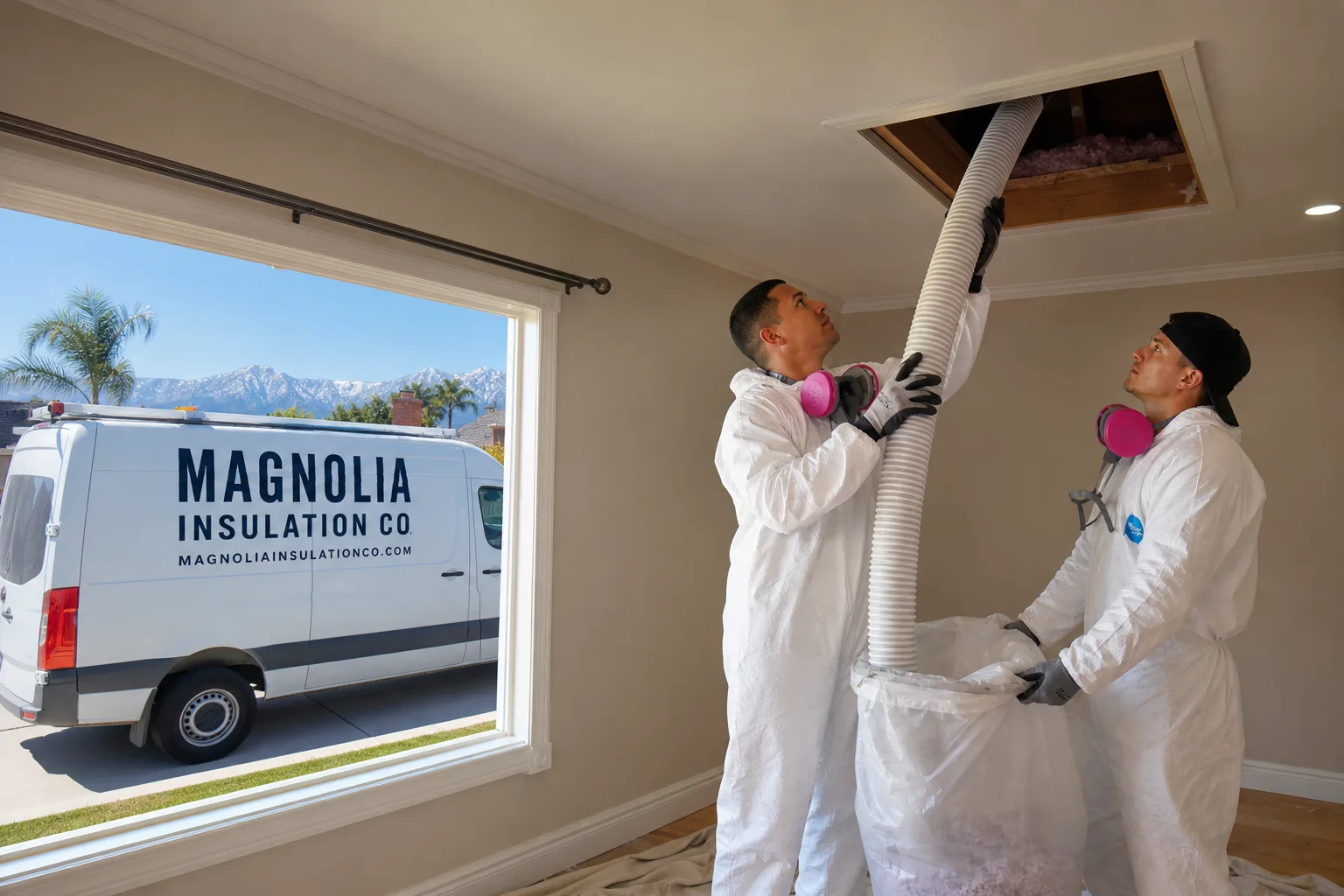
Fast, Reliable Spray Foam Insulation Across East San Gabriel
Spray foam insulation in East San Gabriel typically runs $2.75 to $4.50 per board foot installed, with most attic jobs landing between $1,800 and $4,200 depending on rafter depth and whether baffles are required. Our crews work the 91776 zip code weekly and can usually reach most East San Gabriel homes within 24 to 48 hours of your call. If your 1950s tract home still has its original thin insulation and your upstairs rooms feel like ovens by 4 p.m., we can tell you exactly why before we ever quote a number. Call (866) 464-1714 and we’ll walk you through it.
Why Magnolia Insulation Co Is East San Gabriel’s Preferred Spray Foam Insulation Company
We didn’t pick East San Gabriel as a service area by drawing a circle on a map. We’re here because the housing stock demands a specific kind of insulation expertise, and that’s precisely what our crews train for. The post-WWII tract homes that line the streets near San Gabriel Boulevard and Duarte Avenue were framed with 2×4 rafters, and most of them still have those original bays. That changes everything about how spray foam should be installed here, and we’ve done enough East San Gabriel attics to know the difference between a job that will hold up for 20 years and one that will delaminate in two.
Homeowners across East San Gabriel have told us the same thing: they want someone who understands their specific house, not a generic foam installer working off a template. Glen Pacheco built our approach around that. We’re authorized installers for Icynene and Demilec spray foam systems, two of the most recognized foam lines in North America, and we carry both open-cell and closed-cell options so we can match the foam to the house, not the other way around. When you call (866) 464-1714, you’ll talk through your attic’s actual condition with someone who knows what a 1953 stucco home on a low-pitch roof needs.
Spray Foam Insulation Contractors in East San Gabriel
Spray foam insulation contractors in East San Gabriel face a challenge that installers in newer communities rarely see: original 2×4 rafter bays that are too shallow for code-minimum foam thickness without modification. Most East San Gabriel post-WWII tract homes were built with exactly 3.5 inches of rafter depth, and many still carry their original thin batts or settled blown-in material. We approach every job here by first checking rafter depth, eave ventilation, and existing insulation condition before recommending open-cell or closed-cell foam.
Shallow-Bay Retrofits
When we spray closed-cell foam in original 2×4 bays, we install rigid foam baffles at the eave first. That preserves the 1-inch ventilation gap that keeps your roof deck from overheating. Without the baffle, foam seals the eave and traps San Gabriel Valley heat against the shingles. Expect $3.00 to $4.50 per board foot for closed-cell work that includes baffle installation.
Open-Cell Attic Conversions
Open-cell foam runs $2.75 to $3.75 per board foot and works well for interior attic applications where you’re not fighting the same ventilation constraints. It air-seals effectively and handles sound dampening better than closed-cell, which matters in East San Gabriel homes where bedrooms sit directly under the roof line.
Spray Foam Attic Insulation in East San Gabriel
Spray foam attic insulation in East San Gabriel most often means sealing the roofline of a 1950s or 1960s stucco home whose original insulation has failed. Attic temperatures here routinely hit 140°F on summer afternoons, which settles old blown-in fiberglass and compresses kraft-faced batts until their R-value drops well below what the label promised. We see it constantly. The fix isn’t more of the same material; it’s an air seal that stops heat from entering the living space in the first place.
The Baffle-First Method
Most East San Gabriel homes still have their original 2×4 rafters, and spraying foam directly against the roof deck without baffles blocks the eave ventilation those houses were designed for. Our crews install rigid foam baffles at every eave before applying 2 to 3 inches of closed-cell foam to the underside of the deck. This keeps the shingles from cooking from below and gives you a proper thermal boundary.
Legacy Insulation Removal
Closed-cell foam sprayed directly over settled, dust-laden blown-in fiberglass adheres poorly. As the old material compacts further under 140°F heat, the foam can delaminate. We remove or stabilize legacy insulation before we spray, which adds labor to the job but prevents a failure that would cost far more to correct later. Full attic prep and spray foam in East San Gabriel typically lands between $3,000 and $4,200 for a single-story home.
Trusted Brands We Service in East San Gabriel
We install both Spray Foam Insulation systems from Icynene and Demilec, and we stock the baffles, canisters, and prep materials needed for East San Gabriel’s shallow-rafter retrofits locally. That matters when your contractor has to wait three days for a part. We also work with Owens Corning and GreenFiber blown-in products when a hybrid approach makes sense for a particular attic. Eight brands, one recommendation: the right material for your specific home. That’s how Glen Pacheco runs every East San Gabriel job, and it’s why we don’t push one foam system on every house we see.
Common Spray Foam Insulation Problems We See in East San Gabriel Homes
- Foam sprayed tight to the roof deck without baffles. In original 2×4 rafter bays, this blocks eave ventilation and traps heat against the shingles, shortening roof life and driving attic temperatures even higher on summer afternoons.
- Closed-cell foam over settled legacy insulation. We regularly see delamination on East San Gabriel homes where a previous contractor sprayed directly over compacted fiberglass. The old material keeps settling, and the foam loses its bond.
- Sealing over active stucco leaks. 1950s stucco walls can hide moisture intrusion, and spraying closed-cell foam over an active leak seals that water into the wall cavity. We scan before we spray on every wall application.
- Ignoring the low-pitch roof geometry. East San Gabriel’s low-slope roofs leave little attic clearance, which means installers must work in confined spaces and use baffles creatively to preserve even the small ventilation gap these homes have.
Pricing for Spray Foam Insulation in East San Gabriel, CA
Open-cell spray foam in East San Gabriel runs $2.75 to $3.75 per board foot installed. Closed-cell runs $3.00 to $4.50 per board foot, with the higher end typically reflecting baffle installation in original 2×4 bays. A full attic spray foam job on a 1950s single-story tract home usually lands between $1,800 and $4,200, depending on attic square footage, rafter depth, and whether legacy insulation needs removal. Rim joist spray foam runs $300 to $900 for most East San Gabriel homes, and garage ceiling spray foam typically falls between $1,000 and $2,500. The biggest cost variable here is prep work: houses with collapsed kraft-faced batts or settled blown-in require removal labor that newer homes don’t. Call (866) 464-1714 for a free estimate based on your attic’s actual condition, not a square-foot guess.
We Also Serve Cities Near East San Gabriel
Magnolia Insulation Co is based in Rancho Cucamonga, and we run crews throughout the San Gabriel Valley. In addition to East San Gabriel, we regularly install spray foam in San Gabriel, Rosemead, San Marino, and North El Monte. If you’re anywhere in the 91776 area or within 15 minutes of San Gabriel Boulevard, we can get to you quickly.
Serving East San Gabriel, CA — Our Local Coverage Area
We’re based in the East San Gabriel area and know this community well. Use the map below to see our service coverage — if you’re nearby, we can almost certainly help.
FAQs About Spray Foam Insulation in East San Gabriel
Yes, but it requires the baffle-first method we described above. Original 2×4 rafters are only 3.5 inches deep, and code-minimum closed-cell foam won’t fit properly without blocking eave ventilation. We install rigid foam baffles at the eave to preserve the 1-inch air gap, then spray 2 to 3 inches of closed-cell foam against the roof deck inside the bay. Most East San Gabriel homes we work on get exactly this treatment. Call (866) 464-1714 and we can tell you whether your rafters are the original 2x4s or have been modified.
Only if it’s installed wrong, and we’ve seen that failure mode here more than once. The risk isn’t the foam itself; it’s sealing over an existing moisture problem. That’s why we scan stucco walls for active leaks before spraying any closed-cell product. When applied to a dry, properly ventilated attic, spray foam reduces moisture problems because it stops humid air from condensing against the roof deck. The key on 1950s East San Gabriel homes is never skipping the moisture check. Call (866) 464-1714 and we’ll include the scan with every wall application quote.
For East San Gabriel’s low-slope roofs and 140°F attic summers, spray foam outperforms blown-in because it air-seals, not just insulates. Blown-in fiberglass or cellulose slows heat transfer but doesn’t stop air movement, and air leakage is what makes upstairs bedrooms hit 88°F by 5 p.m. in July. Spray foam creates a continuous thermal boundary at the roof deck. That said, blown-in GreenFiber cellulose works well in some flat-ceiling attics here, and we’ll recommend it when the structure calls for it. Eight brands, one recommendation. Call (866) 464-1714 for an attic assessment.
We install Icynene and Demilec spray foam systems, two of the most established foam platforms available to residential contractors. Icynene’s closed-cell formula is what we use most often in East San Gabriel’s shallow 2×4 bays because it delivers high R-value per inch. Demilec’s open-cell product works well in interior applications where sound control matters. We also carry Owens Corning and GreenFiber blown-in materials for hybrid jobs. The brand choice hinges on your attic’s geometry, not our inventory. Call (866) 464-1714 for specifics.
In most East San Gabriel homes built before 1970, yes. The original kraft-faced batts or blown-in fiberglass have typically settled, compacted, or absorbed decades of dust, and closed-cell foam won’t bond reliably to that surface. Leaving it in place risks delamination as the old material continues to settle under attic heat. We remove or stabilize legacy insulation before spraying, which adds prep labor but prevents a failure that would require tearing out the foam later. Call (866) 464-1714 and we’ll tell you whether your existing insulation can stay.
On a 1953 single-story stucco tract home near San Gabriel Boulevard and Duarte Avenue, we found the original attic kraft-faced batts collapsed and the roof deck heat-soaked to 140°F by midafternoon. We installed foam baffles in the shallow 2×4 bays, sprayed 2 inches of closed-cell Icynene against the deck, and the homeowner reported the second-floor bedroom, previously 88°F at 5 p.m., held at 78°F the following week. That’s the job we do in East San Gabriel every week, and it’s why we show up with baffles already on the truck.
Contact Magnolia Insulation Co for Spray Foam Insulation in East San Gabriel
If your East San Gabriel home still has its original thin insulation and your summer cooling bills keep climbing, we can fix the root cause. Call (866) 464-1714 today for a free, no-pressure estimate. Glen Pacheco and our crews know 91776 attics, and we’ll give you a straight answer about what your house actually needs, even if that means telling you spray foam isn’t the right call.
Written by Glen Pacheco, Owner at Magnolia Insulation Co, serving East San Gabriel and the surrounding San Gabriel Valley.