
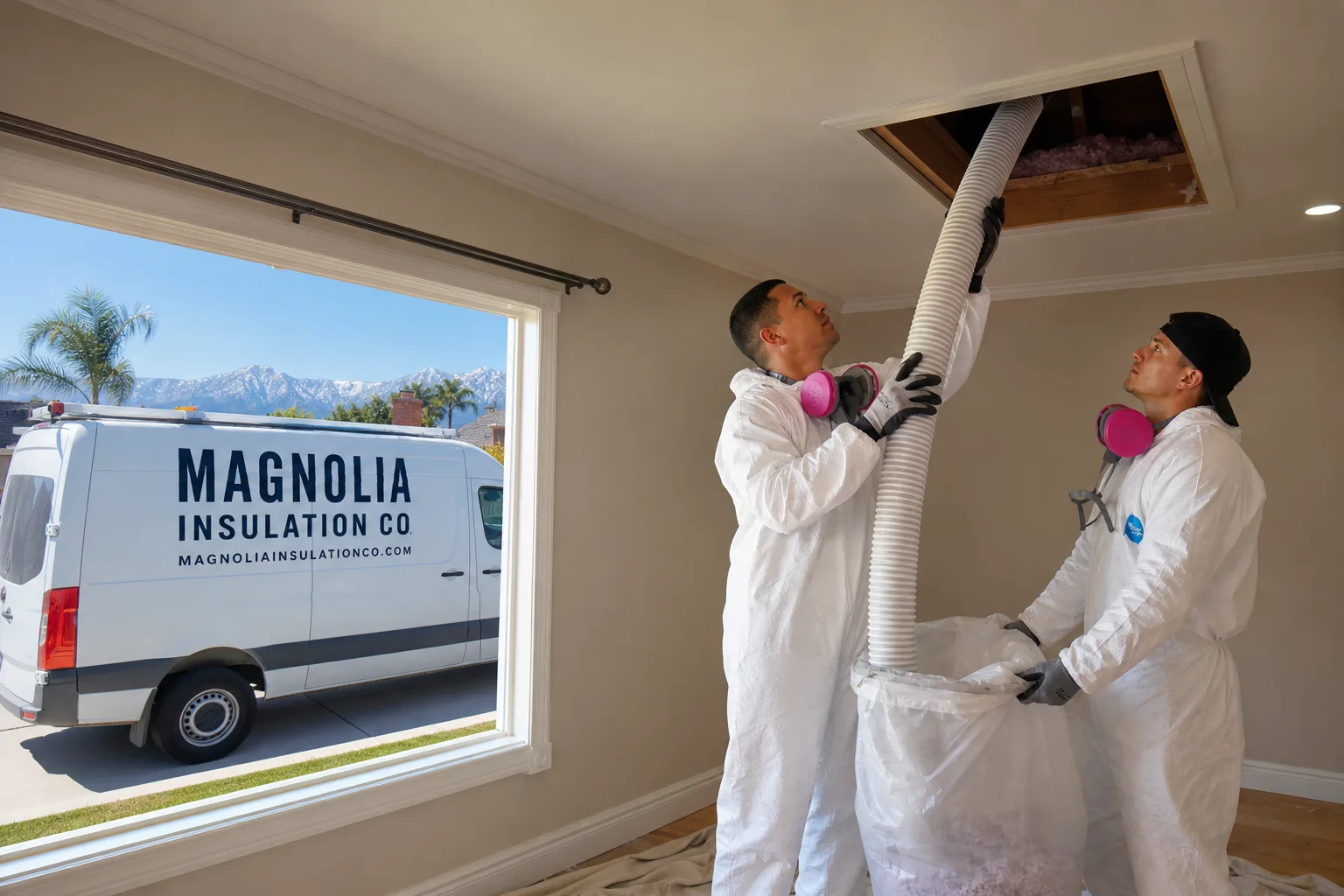
Spray Foam Insulation in Brea: The Two-Climate Problem
Spray foam insulation in Brea isn’t a one-spec-fits-all job. A valley-floor tract home off Birch Street and a hillside house in 92823 may be five miles apart, but they face completely different thermal and wind conditions. Brea sits at the transition between the flat Orange County basin and the Chino Hills, which means the right foam choice, open-cell or closed-cell, depends heavily on which side of that line your home sits on. Call (866) 464-1714 and we’ll walk through what your specific house actually needs.
We’ve worked in Brea long enough to know that a 1963 ranch home in 92821 doesn’t need the same roof deck treatment as a 2005 master-planned home off Carbon Canyon Road. Most insulation contractors treat Brea like any other Orange County city. That’s a mistake, and your utility bill shows it every August.
Fast, Reliable Spray Foam Insulation Across Brea
We run crews into Brea from our Rancho Cucamonga shop most days of the week. Response time to most Brea zip codes, 92821, 92822, and 92823, runs same-day for estimates and within a few days for standard installations. If you’ve got an exposed rim joist or a garage ceiling that’s radiating heat into the bonus room above it, that’s a job we can usually schedule quickly. Call (866) 464-1714, tell us what you’re dealing with, and we’ll give you a straight answer on timing.
Being based just up the 57 means we understand Brea’s position as Orange County’s inland edge. The summer heat here is not the coastal marine layer heat of Newport or Huntington. It’s a dry, relentless, high-90s heat that bakes attics for five straight months. That changes how spray foam should be specified in Brea, and it’s why we don’t just copy the same insulation plan from city to city.
Why Magnolia Insulation Co Is Brea’s Preferred Spray Foam Insulation Company
Brea homeowners tend to research before they buy. They’ve got the energy bills, they’ve felt the upstairs of the house hit 83 degrees by 2 PM in July, and they want to know exactly what’s going on before anyone opens a hole in the drywall. That’s the customer we work for. We walk you through the building science in plain English: what’s happening with airflow, why your attic hits the temperature it does, and where spray foam actually pays for itself.
Glen Pacheco built Magnolia Insulation Co around a simple idea: recommend the right material for the specific home, not the material we happen to have the most of on the truck. That means when we show up in Brea, we’re not trying to force a one-product solution on a city with two very different housing types. We carry Icynene and Demilec spray foam lines, which lets us choose open-cell or closed-cell based on your roofline, your exposure to the Santa Ana corridor, and your budget, not based on what we need to move this quarter.
Our reputation across Brea comes from solving the problems other contractors missed. We find wind-washed batt sections on gable ends facing the Chino Hills. We find roof deck foam applied over settled insulation that should have been pulled out first. We find garage ceilings with original builder-grade batt that has sagged into uselessness. When we fix those things, the results show up on the next utility bill.
Garage Spray Foam Insulation in Brea
Garage Spray Foam Insulation in Brea solves a problem that’s especially common in the 1960s and 70s valley-floor tract homes throughout 92821 and 92822: the garage ceiling is a thermal hole. The builder stuffed a thin layer of batt above the garage drywall, it has settled and compressed, and now the hot attic air above your garage cooks the bonus room or bedroom that sits above it. On long Brea afternoons, that garage ceiling can read 110 degrees on an infrared thermometer, and all that heat is moving right up into the house.
A typical garage ceiling spray foam job in Brea runs $1,800 to $3,400 depending on garage footprint, access, and whether we’re also sealing the rim joists. The foam we apply expands to fill every cavity, eliminates the air gaps that batts leave, and turns the garage ceiling from a heat pipeline into an actual thermal boundary. Most jobs are done in a day.
What the Job Involves
We clean out the cavity, verify there’s no wiring issue hiding in the joist bays, and then apply spray foam directly to the underside of the ceiling deck above the garage. If the rim joists along the garage’s perimeter are exposed, we address those in the same visit, since air leakage through the rim is a major contributor to garage heat and cold air intrusion in winter.
Signs You Need It in Brea
If the room above your garage is consistently 5 to 8 degrees warmer than the rest of the upstairs in summer, that’s the classic sign. If the garage itself feels like a furnace by early afternoon, even with the door closed, the ceiling thermal barrier has failed. Call (866) 464-1714 and we’ll confirm what’s going on before you spend a dime.
Closed Cell Spray Foam Insulation in Brea
Closed Cell Spray Foam Insulation in Brea is the right choice for a specific set of conditions, and they show up most often on the canyon side of the city. In the 92823 hills above the valley floor, homes face Santa Ana wind events that open-cell foam cannot handle on exposed surfaces. Closed-cell foam, typically applied at 2 to 3 inches, acts as an air barrier, a vapor barrier, and an insulation layer in a single pass, and it has measurable structural strength and fire-resistance characteristics that matter near the Brea hills.
Closed-cell foam in Brea typically runs $2.50 to $4.50 per board foot installed, depending on depth and application area. For rim joists, roof decks on cathedral ceilings, and any surface exposed to wind-washing, it is the only foam we will recommend. The denser cell structure means it won’t let wind-driven air tear through it the way open-cell can when directly exposed.
Where Closed Cell Belongs
On the windward gable end of a hillside Brea home, closed-cell foam stops the air movement that open-cell cannot. On a vaulted ceiling with no attic space above it, closed-cell gives you the vapor and air control in one layer. And anywhere in Brea where ember exposure during Santa Ana conditions is a concern, closed-cell provides a more fire-resistant assembly than any open-cell equivalent.
When Open-Cell Is the Better Fit
For valley-floor tract homes where the main enemy is radiant heat gain rather than wind, open-cell foam at the roof deck often costs less and performs well when correctly specified. We will tell you which one belongs on your specific house. That’s the whole point of being material-agnostic.
Trusted Brands We Service in Brea
Magnolia Insulation Co installs spray foam from Icynene and Demilec, two of the most technically advanced foam systems available in North America. We also carry GreenFiber blown-in cellulose and Owens Corning products for hybrid approaches, which is sometimes the right answer on older Brea homes where full spray foam isn’t the best fit. Because we’re authorized across multiple brands, we don’t have to force a square peg into a round hole. We stock materials for Brea jobs in our Rancho Cucamonga yard, which keeps turnaround fast when a Brea homeowner calls on a Tuesday and wants an answer by Friday.
Common Spray Foam Insulation Problems We See in Brea Homes
- Wind-washed open-cell foam on hillside gable ends. On several 92823 homes we’ve opened up, open-cell foam on the roof deck was left exposed at the gable end facing the Santa Ana corridor. Wind-driven air had scoured the surface and destroyed the thermal performance. These sections need closed-cell foam.
- Garage ceilings with sagged builder batt. Valley-floor tract homes in 92821 and 92822 often still have the original garage ceiling insulation from the Nixon administration. It has settled, compressed, and in many cases fallen away from the drywall entirely. The rooms above those garages suffer all summer.
- Roof deck foam applied over settled original insulation. We’ve seen 1960s Brea homes where spray foam was installed on the roof deck but the original cellulose or batt below was never removed. The old material keeps settling, leaves gaps, and the foam above it is doing only half its job.
- Rim joist gaps in newer master-planned homes. The newer construction in the 92823 hills looks tighter than it is. Rim joist bays along the garage and the house perimeter are frequently left with nothing but a fiberglass batt stuffed into the cavity, which does nothing to stop air movement. Winter heat loss in the canyon side of Brea runs right through those gaps.
Pricing for Spray Foam Insulation in Brea, CA
Garage ceiling spray foam in Brea typically runs $1,800 to $3,400, depending on square footage and whether rim joist work is included. Closed-cell foam for a rim joist package runs $1,500 to $3,000 on most single-family Brea homes. A full roof deck foam application on a 1,800-square-foot attic, depending on open-cell versus closed-cell and existing insulation removal, runs $6,500 to $14,000. What moves the number is access, the condition of what’s already in the cavity, and whether we’re working around vaulted ceilings or complex rooflines. Call (866) 464-1714 for a free estimate and a line-item price. No games.
We Also Serve Cities Near Brea
Magnolia Insulation Co serves Brea and the surrounding communities, including Placentia, Rowland Heights, Fullerton, and Yorba Linda. If you’re in a neighboring city and wondering whether we cover your street, call (866) 464-1714. Chances are we do, and our Spray Foam Insulation team can talk you through the specifics for your home’s exposure and construction type.
Serving Brea, CA — Our Local Coverage Area
We’re based in the Brea area and know this community well. Use the map below to see our service coverage — if you’re nearby, we can almost certainly help.
FAQs About Spray Foam Insulation in Brea
Because the original builder insulation in those 1960s and 1970s homes was never adequate, and five months of inland heat has spent decades baking it into uselessness. The garage ceiling is the largest unaddressed thermal boundary in most Brea valley-floor homes, and spray foam is the only material that both insulates and air-seals that cavity in one pass. Call (866) 464-1714 and we’ll tell you whether your garage ceiling is the problem.
Yes, in almost every case. Canyon homes in 92823 face Santa Ana wind exposure and greater diurnal temperature swings, which means closed-cell foam on windward gable ends, rim joists, and any cathedral ceiling is the correct call. Valley-floor homes off Birch Street or Imperial Highway are fighting afternoon attic heat gain, not wind-washing, so the spec shifts accordingly. A contractor who doesn’t know this difference isn’t serving Brea properly.
No, not over settled or degraded original insulation. On a 1960s tract home, the original batts or blown material has usually settled into a dense, dirty mat that won’t allow foam to adhere properly. The correct sequence is to remove the old material, verify the deck and framing are in good shape, and then apply foam. Skipping that step is how you end up with foam that looks good from the hatch but does nothing at the thermal boundary.
Often yes, especially at the rim joists and the garage ceiling. Builders in Brea’s newer developments meet minimum code, and minimum code doesn’t account for the inland heat load or the Santa Ana wind corridor the 92823 hills see every fall. The garage ceiling is frequently the weakest point, with a thin batt that sagged away from the drywall within a few years. Spray foam on that surface fixes the problem permanently.
Yes, closed-cell foam has a denser, more fire-resistant cell structure than open-cell foam, and it is the standard recommendation for any assembly that could face ember exposure during a Santa Ana event in the Brea hills and canyon edges. We specify closed-cell on windward gable ends, roof decks on hillside homes, and anywhere else in the 92823 area where wind-driven fire exposure is a legitimate concern. Call (866) 464-1714 and we’ll explain what belongs on your specific house.
Written by Glen Pacheco, Owner at Magnolia Insulation Co, serving Brea and the surrounding Orange County communities.