
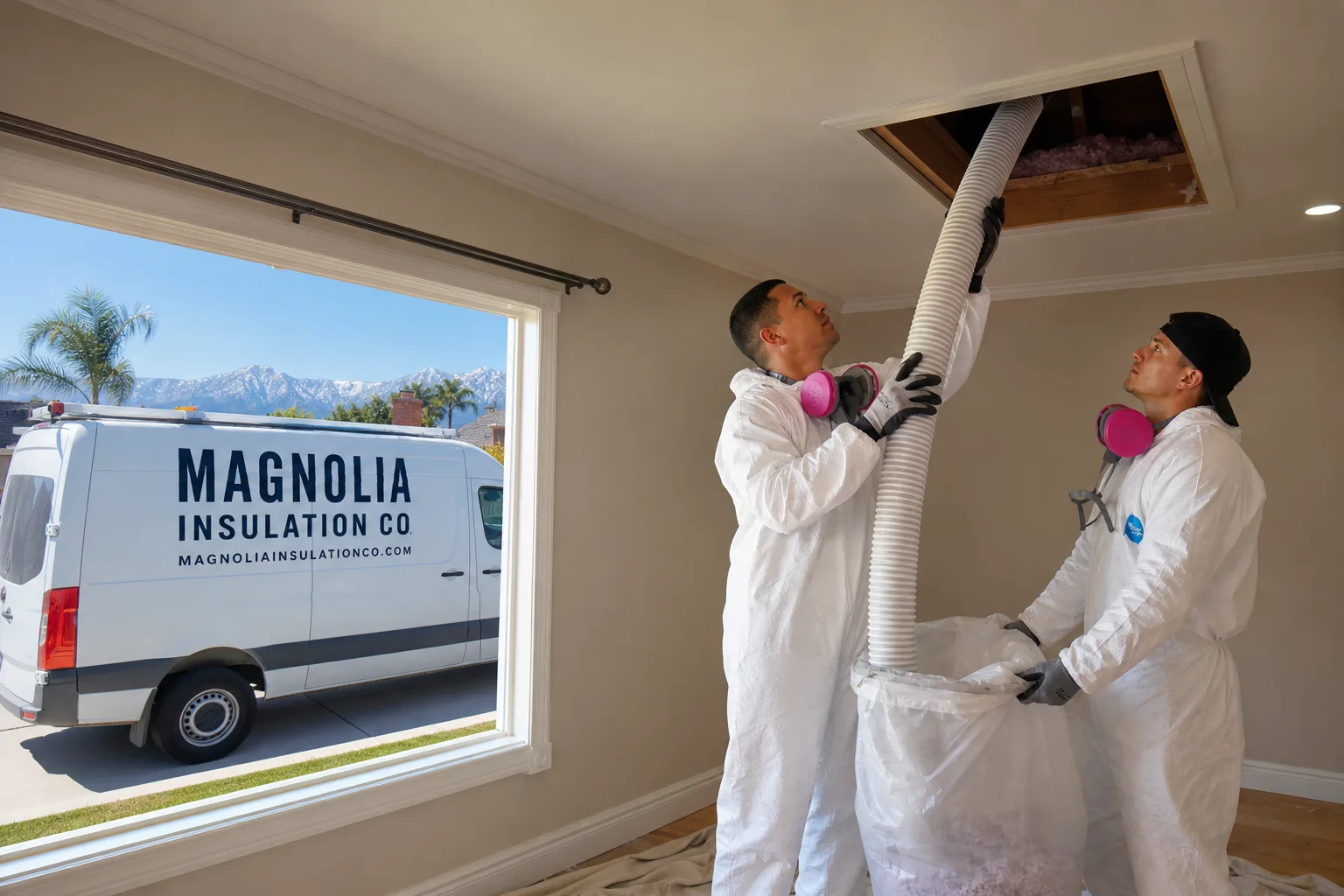
Fast, Reliable Attic Insulation Across Fontana
Attic insulation in Fontana is not a one-size-fits-all job. The single biggest factor is which era your home was built in: older central Fontana tracts from the 1950s – 70s in 92335 and 92337 typically need compressed, rodent-disturbed batt removed and air-sealed before anything new goes in, while the 1980s – 2000s stucco subdivisions up in 92336 usually need R-value top-offs and attic access hatch sealing rather than full tear-outs. Our crews work both sides of that divide every week. We’re based in Rancho Cucamonga and we get to Fontana fast, usually same-day for an inspection. If you’re looking at a hot upstairs hallway or a cooling bill that keeps climbing, call Glen Pacheco’s team at Magnolia Insulation Co at (866) 464-1714 for a free estimate.
Why Magnolia Insulation Co Is Fontana’s Preferred Attic Insulation Company
Fontana homeowners call us because we diagnose before we recommend. It’s the material-agnostic approach: we carry eight brands across fiberglass, mineral wool, spray foam, and recycled cellulose, so the answer fits your attic, not our inventory. In the older 92335 tracts where original batts have been shredded into rodent nesting material, we’ll say so and show you why removal plus air sealing matters more than piling new insulation on top. In a 2004 stucco two-story in the northern 92336 growth area, our crew found builder-grade R-13 batts sagging away from the low-pitch ceiling line and a radiant barrier that Santa Ana wind cycling had loosened. We air-sealed the top plates and can lights, brought the attic to a modern R-value with Johns Manville batts, and re-tensioned the radiant barrier. Our tech also noted the builder-grade attic access hatch had no gasket or insulation cap, a common corner-cut in these tract builds that lets 130°F-plus attic air leak straight into the hallway. Those are the details that separate a real insulation specialist from a company that just blows fiberglass and leaves.
We carry Attic Insulation materials from Owens Corning, Johns Manville, Knauf, Rockwool, CertainTeed, Icynene, Demilec, and GreenFiber. Three installation methods under one roof: attic insulation, spray foam, and blown-in. Attic to crawlspace, batt to foam.
Attic Ventilation in Fontana
Attic ventilation in Fontana is a cooling-cost issue first and a moisture issue second. The Inland Empire sun loads attics so hard that even a well-insulated ceiling struggles when trapped 140°F air has nowhere to go. Proper intake and exhaust ventilation pulls that superheated air out and pushes cooler outside air through, which means your insulation works less to hold back the heat. If you’re in a 1950s – 70s ranch in 92335, your attic likely has original gable vents or a single roof vent that was never enough. In the 1980s – 2000s subdivisions up north in 92336, we often find soffit vents that are actually blocked by fresh stucco or insulation that was shoved tight against the eaves when the house was built. A full attic ventilation assessment in Fontana runs $150 – $400 depending on attic size and access difficulty, while adding or replacing vents is typically $350 – $900.
Baffles and Eave Correction
When we add attic insulation in Fontana, we install baffles at the eaves so new material never blocks your soffit vents. In low-pitch attics common to the northern 92336 tract builds, this is tight work: the pitch leaves little room to reach, and without baffles the new insulation drifts straight over the intake and starves the attic of airflow. Baffle installation runs $4 – $8 per baffle on most Fontana jobs, usually 10 – 24 baffles depending on the number of rafter bays and eave length.
Powered Vent and Ridge Vent Retrofit
For Fontana attics that still hold heat at sunset, we retrofit powered attic ventilators or ridge vents. A powered vent with thermostat mounts where an old static vent sits and moves 1,000-plus CFM of hot air out during peak afternoon heat. The cost in Fontana runs $550 – $1,100 installed including wiring. Ridge vents for low-pitch roofs in the 92336 subdivisions depend on ridge length but typically run $900 – $1,800 for a full run, and they work silently, which matters when your master bedroom sits directly under the roofline.
Radiant Barrier in Fontana
Radiant barrier in Fontana addresses the single biggest daytime heat vector: the sun baking your roof deck and radiating heat straight down onto the insulation below. A properly installed reflective barrier stapled to the underside of the rafters cuts radiant heat transfer into the attic, and in Fontana’s 100°F-plus summers that’s the difference between a 130°F attic and a 115°F attic. It does not replace insulation; it makes your insulation’s job easier. In the low-pitch 92336 tract homes, radiant barrier installation runs $900 – $1,600 for a typical 1,200 – 1,800-square-foot attic footprint.
Santa Ana Wind Loosening
We see it every October through February: Santa Ana wind events funneling down the Cajon Pass hammer Fontana attics and loosen radiant barrier facing that was stapled 12 or more years ago. When loose barrier flutters and detaches, it drops the whole attic’s reflective surface area and leaves bare hot spots on the ceiling below. Re-tensioning and re-stapling loose radiant barrier runs $180 – $350 on most Fontana attics, and we do it as part of any top-off or vent work when needed.
Radiant Barrier on Low-Pitch Attics
Low-pitch attics in Fontana’s northern subdivisions leave little room between the roof deck and the ceiling, which is exactly why radiant barrier makes sense. The smaller the attic air volume, the faster it heats up, and reflected heat is the one variable you can reduce without adding thermal mass. We install barrier specifically sized for low-pitch rafter bays, and we always leave the required 1-inch air gap at the ridge and eaves so you never trap heat behind the foil.
Trusted Brands We Service in Fontana
We stock and install Rockwool mineral wool, CertainTeed fiberglass, Icynene spray foam, and Demilec spray foam among our eight lines, and we choose per job. When a Fontana homeowner wants fire resistance and sound damping, Rockwool outperforms standard batt. When an older 92335 attic needs air-sealing plus R-value with moisture resilience, CertainTeed batts fit the joist bays we’re working in. When a low-pitch 92336 attic needs open-cell foam to seal and insulate in one pass, Icynene does it cleanly. Eight brands, one recommendation. The right material for your specific home.
Common Attic Insulation Problems We See in Fontana Homes
- Builder-grade attic access hatches with no seal. In the 1980s – 2000s stucco subdivisions across northern 92336, the access hatch ships as a raw drywall panel with no gasket and no insulation cap. The result is a 130°F-plus attic leaking heat straight into an upstairs hallway all summer. We add a foam cap and gasket for $120 – $220 per hatch, usually under an hour.
- Santa Ana wind damage to loose-fill and radiant barrier. Wind events along the Cajon Pass corridor blow loose-fill insulation into drifts against one side of the attic, leaving bare ceiling areas on the other. We re-level and top off drifted cellulose or fiberglass and re-staple loosened barrier facing.
- Sagging and compressed original batts in low-pitch attics. Decades of Inland Empire heat cycling cause R-11 and R-19 fiberglass batts in 1980s – 2000s low-pitch attics to compress and pull away from the ceiling line. Re-tensioning or replacing these batts is usually a top-off job rather than a full gut.
- Rodent intrusion in the older 92335 tracts. The 1950s – 70s ranch homes in central and southern Fontana have soffit gaps and original vents that rats and mice have used for decades. When batt insulation becomes nesting material, it must be removed and replaced, and the attic air-sealed at every penetration before any new insulation goes down.
Pricing for Attic Insulation in Fontana, CA
Attic insulation in Fontana runs on a wide band because scope depends almost entirely on build era and current condition. A straight blown-in attic insulation top-up over existing batts in a 92336 tract home runs $1,200 – $2,200 for a 1,200 – 1,800-square-foot attic. Attic batt insulation for a full replacement in an older 92335 ranch runs $2,100 – $3,800 including removal of the old compressed or rodent-disturbed material. Attic insulation replacement where air sealing is included, which we recommend on any pre-1980 Fontana home, runs $2,900 – $4,900 depending on attic accessibility and the number of penetrations to seal. Attic baffles and ventilation prep are priced per the figures in the sections above. Every Fontana estimate is free, and we give you an itemized scope before any work starts. Call (866) 464-1714 for exact numbers on your attic.
We Also Serve Cities Near Fontana
Our crews run the same diagnostic-first approach across Bloomington, Rialto, Glen Avon, and Pedley, all within 15 minutes of our Rancho Cucamonga base. If you’re in any of those nearby cities, the same team handles your job. For a full picture of our coverage area, see Attic Insulation in Fontana and surrounding Inland Empire communities.
Serving Fontana, CA — Our Local Coverage Area
We’re based in the Fontana area and know this community well. Use the map below to see our service coverage — if you’re nearby, we can almost certainly help.
FAQs About Attic Insulation in Fontana
Yes, in most cases. Fontana’s 1980s – 2000s subdivisions in the northern 92336 growth areas were built with original R-11 to R-19 fiberglass batts, which falls short of what Title 24 now requires and what Inland Empire summers demand. The builder also typically skipped gaskets and insulation caps on attic access hatches, so a 130°F-plus attic leaks heat straight into your living space no matter how many inches of insulation sit over the ceiling. Call (866) 464-1714 and we’ll inspect your attic and tell you exactly what’s there now.
Fontana sits in the hot, dry inland valley northeast of the Cajon Pass, where summer highs routinely exceed 100°F and the sun loads attics with intense solar radiation for 10-plus hours a day. Coastal LA gets the marine layer and afternoon ocean breeze; Fontana gets direct inland sun with no moderating effect. That’s why radiant barrier and attic ventilation matter more here than they would in a coastal attic.
We check for rodent-disturbed and compressed original batt insulation. In the 1950s – 70s ranch homes across central and southern Fontana, decades of heat cycling have flattened and degraded the original batts, and the soffit gaps and old vents have let in rats and mice that turned sections of it into nesting material. If you add new insulation on top of that without removing and air-sealing first, you’re burying the problem. Our inspection starts there every time.
Yes, and in many 92336 tract homes it makes more sense than adding thick insulation. Low-pitch attics have a small air volume that heats up fast, and by the time you add enough insulation to cut radiant heat transfer, you’ve eaten into an already tight space. A radiant barrier stapled to the underside of the rafters reflects the roof deck’s radiant heat before it ever hits the insulation, which keeps the whole attic cooler with zero added thickness.
Stand in the hallway directly under your attic access hatch at 4 p.m. on a summer afternoon. If you feel heat radiating down from the ceiling panel, or if the trim around the hatch is noticeably warmer than the surrounding drywall, your hatch has no gasket and no insulation cap. That gap lets 130°F-plus attic air pull straight into the conditioned space, and it’s a 30-minute, $120 – $220 fix. Call (866) 464-1714 and we’ll come cap it, usually same week.
Written by Glen Pacheco, Owner at Magnolia Insulation Co, serving Fontana and the Inland Empire with attic insulation, spray foam, and blown-in solutions.