Fast, Reliable Attic Insulation Across Corona
Attic insulation in Corona is a heat-defense problem before anything else. Summer afternoons routinely exceed 100°F, attic temperatures can spike past 150°F, and Santa Ana winds push fine Temescal Valley dust into vented attics across every hillside tract. That combination is why Magnolia Insulation Co responds quickly to Corona homeowners from 92882 to 92883: we know exactly what fails here, what it costs to fix, and which material belongs in which attic. Call (866) 464-1714 for a free estimate, and we’ll be out to your Corona home fast, attic ladder down, diagnosing what your builder never told you.
Why Magnolia Insulation Co Is Corona’s Preferred Attic Insulation Company
Corona homeowners call us after they’ve spent two or three summers fighting an upstairs that won’t hold temperature. They know their R-19 builder-grade batts are doing very little against a 150°F attic, but they need someone who can explain the fix without a product pitch. Glen Pacheco leads a team that carries eight insulation brands and three installation methods, so the recommendation for your Sierra Del Oro home won’t be the same as the recommendation for a 1960s tract house near downtown Corona. Our Attic Insulation crew has worked in Horsethief Canyon, off Green River Road, and through the 92880 subdivisions. The work we do in Corona isn’t copy-paste from Riverside or Chino: we air-seal for Santa Ana dust intrusion, spec insulation for radiant heat gain, and inspect attic ventilation before adding anything. That’s the difference between a quote from a brand-rep and a plan from an installer.
Attic Mold Removal in Corona
Attic mold removal in Corona is a service we get asked about more than homeowners expect, because this climate doesn’t read as “moldy.” But Corona’s summer humidity spikes, followed by warm attic air and poor ventilation, create condensation against roof sheathing, especially in newer 92880 and 92881 homes with tight building envelopes. When Santa Ana winds clog soffit vents with dust and dead leaves, humid air has nowhere to go. Mold follows, often in the form of black staining along the north-facing sheathing and around bathroom exhaust fan terminations.
Dust-Clogged Vents and Mold Growth
The typical sequence in Corona starts with dust. Fine Temescal Valley silt fills the soffit baffles, intake slows, and attic heat rises. Warm air holds moisture. The first cool night, that moisture condenses on the underside of the roof deck, and mold spores that rode in on the wind find a damp, dark surface. Removing the mold means more than spraying: we strip the contaminated insulation, treat the sheathing, repair the ventilation, and re-insulate. The job typically runs $1,800 to $4,200 in Corona depending on attic size and contamination extent.
When to Suspect Mold in Your Corona Attic
You may notice a musty smell coming from the ceiling register when the AC kicks on, or dark staining around attic access hatches. In homes built before 1985, bathroom fans often vent directly into the attic, which is a mold factory in Corona’s heat. We inspect first, show you photos, and recommend remediation only if it’s actually needed. Call us at (866) 464-1714 if you suspect attic mold. We’ll give you an honest read.
Attic Insulation Removal in Corona
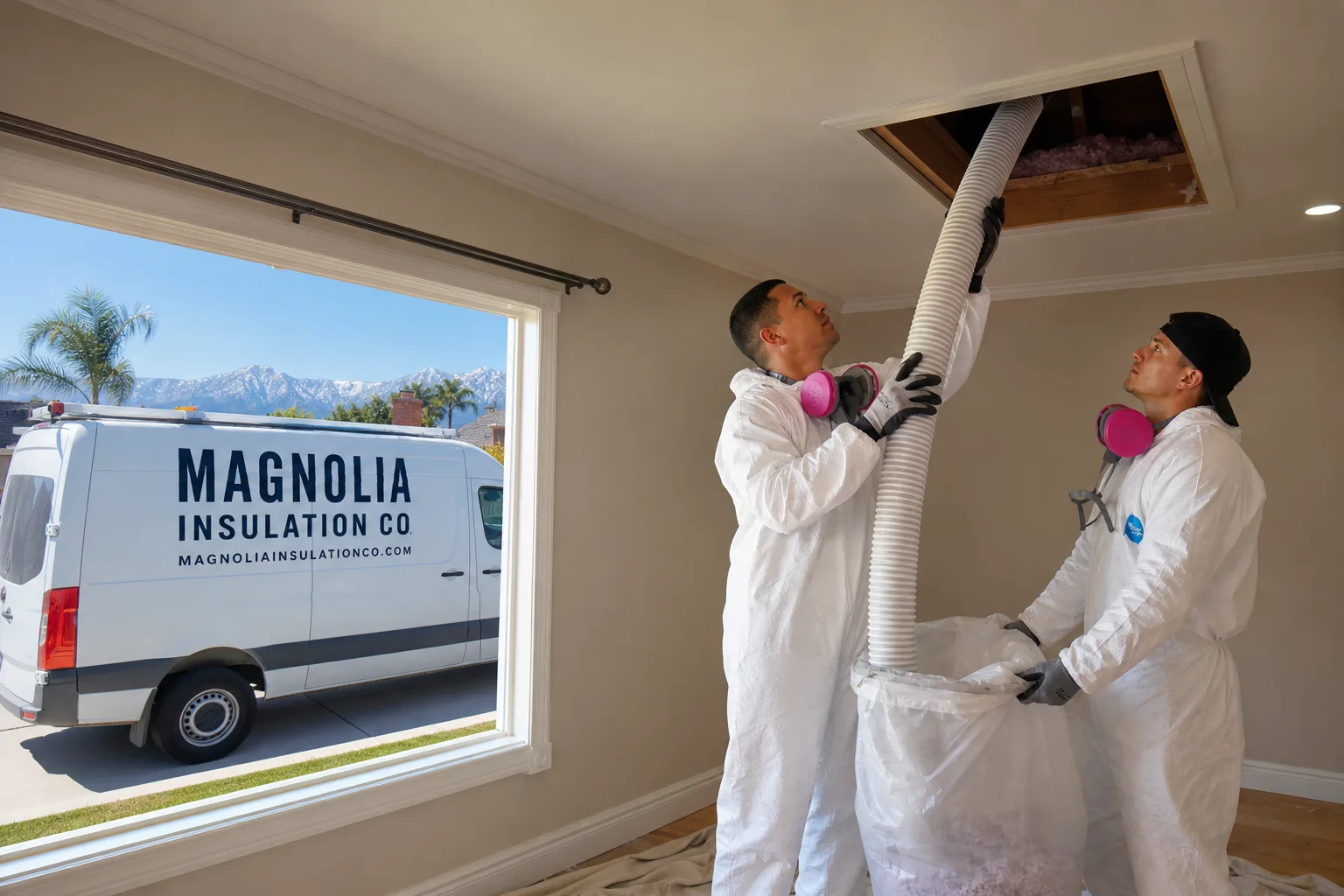
Attic insulation removal in Corona is often the right move before adding new material, especially in the hillside tracts where Santa Ana winds have been packing dust into attics for a decade or more. Old blown-in fiberglass that’s been compressed under windblown silt loses its thermal value and can trap moisture against ceiling drywall. We remove it, bag it, and prep the attic for new insulation, air sealing, and baffle repair. Removal for a typical Corona attic runs $1,200 to $2,800 before new material goes in.
Why Removal Beats Topping Up
Layering fresh insulation over dusty, crushed material doesn’t solve the underlying ventilation problem. In Corona’s windward tracts like Sierra Del Oro, the old insulation is often packed solid along the roofline, leaving bare drywall patches that turn into hot spots. Removal lets us see the top plates, can lights, and plumbing penetrations that need air sealing. That’s the part that actually changes comfort.
Dust-Contaminated Insulation
If your attic has gable vents or older soffit baffles, Santa Ana events have likely deposited a layer of fine silt over everything. That dust holds moisture, degrades fiberglass, and coats your ductwork. Removing the contaminated material before blowing in GreenFiber cellulose or CertainTeed fiberglass gives you a clean thermal boundary, not a band-aid over a dirty problem.
Trusted Brands We Service in Corona
We install and service attic insulation from eight manufacturers, and Corona homeowners benefit from having options, not quotas. If your home needs open-cell spray foam for a cathedral ceiling in a 92883 hillside build, we can spec Icynene or Demilec. If you want a high-recycled-content blown-in product for an older 92882 ranch, we recommend GreenFiber cellulose. If your furnace room shares a wall with a bedroom and you need sound damping plus fire resistance, Rockwool mineral wool is in our truck. Corona attics are not all the same, and the brand should fit the home, not the sales target. We stock the common materials locally for fast turnaround and can order specialty products without sending you to a different contractor.
Common Attic Insulation Problems We See in Corona Homes
- Santa Ana dust clogging soffit vents. Fine silt from the Temescal Valley gets pulled through gable and soffit vents during wind events, choking intake airflow. We find this on nearly every windward-facing home in Sierra Del Oro and Horsethief Canyon.
- Builder-grade R-13 and R-19 batts crushed under foot traffic. In the 1990s and 2000s master-planned subdivisions, original batts get walked down during HVAC and cable installs. Once compressed, they lose half their R-value and let attic heat radiate through ceiling drywall.
- Wind-eroded blown-in insulation near ridge and gable vents. High-velocity Santa Ana gusts displace loose insulation at the windward roofline. We regularly see bare drywall patches inches from the gable ends in 92881 homes.
- Convective loops from unsealed top plates and can lights. In Corona’s summer, a 150°F attic pushes hot air through unsealed penetrations into the living space. Old can lights in 1980s-era homes near downtown are among the worst offenders.
Pricing for Attic Insulation in Corona, CA
Blown-in attic insulation for a standard Corona home typically runs $1,800 to $3,400 for R-38 to R-49 coverage, depending on square footage and prep work. Batting a new construction attic is usually $1.50 to $2.50 per square foot installed. A top-up over existing material runs $900 to $1,700. Full removal and re-insulation starts around $3,000 and can reach $6,500 for larger two-story homes in 92883. The number one cost variable in Corona is attic access and ventilation prep: older homes with narrow scuttle holes and no baffles cost more to do right. We quote flat, not by the hour. Call (866) 464-1714 for a free, no-pressure estimate specific to your attic.
We Also Serve Cities Near Corona
Magnolia Insulation Co serves Corona and the surrounding communities including Home Gardens, El Cerrito Corona, Eastvale, and Norco. If you’re in one of those areas and your attic insulation needs a serious evaluation, call us. Our trucks are already in the corridor, so scheduling is fast.
Serving Corona, CA — Our Local Coverage Area
We’re based in the Corona area and know this community well. Use the map below to see our service coverage — if you’re nearby, we can almost certainly help.
FAQs About Attic Insulation in Corona
That’s Santa Ana wind-driven dust that has blown through your soffit or gable vents and settled into the insulation, compressing it over years. The windward side of your attic becomes a dust trap, and the insulation loses loft and thermal performance. We remove the clogged material, air-seal the top plates, and install dust-filtering baffles before blowing in new material. Call (866) 464-1714 for an inspection.
Your R-19 batts have likely been walked down during HVAC and cable work, or they were never properly fitted around can lights and truss chords. In Corona’s summer heat, a compressed batt and a gaping can-light hole turn the upstairs into an oven. We’d pull back the batts, air-seal the penetrations, and blow in R-49 cellulose or fiberglass. That’s the fix, and it works.
We recommend inspecting your Corona attic insulation every three to five years, more often if your home sits on a windward hillside in Sierra Del Oro or Horsethief Canyon. Wind events erode and dirty insulation over time, even without a leak. A quick visual check of vent airways, depth consistency, and dust buildup catches small problems before August turns them into big ones.
Yes, and in many Corona attics that’s the only right way to do it. We vacuum out dust-contaminated insulation, inspect the attic floor for air leaks, seal penetrations, and then install fresh material. Removing old insulation before adding new prevents the new material from inheriting the old material’s dust, odor, and compression problems. Estimates are free: call (866) 464-1714.
It does, mostly as a condensation problem, not a leak problem. Corona’s hot days create moisture-laden attic air, and when nights cool, that moisture condenses on roof sheathing, especially if dust-clogged vents have starved the attic of airflow. Mold grows in that trapped moisture. We treat the sheathing, fix the ventilation, and replace contaminated insulation. If you smell something musty in your Corona home, call us before it spreads.
Written by Glen Pacheco, Owner at Magnolia Insulation Co, serving Corona and the Temescal Valley.