
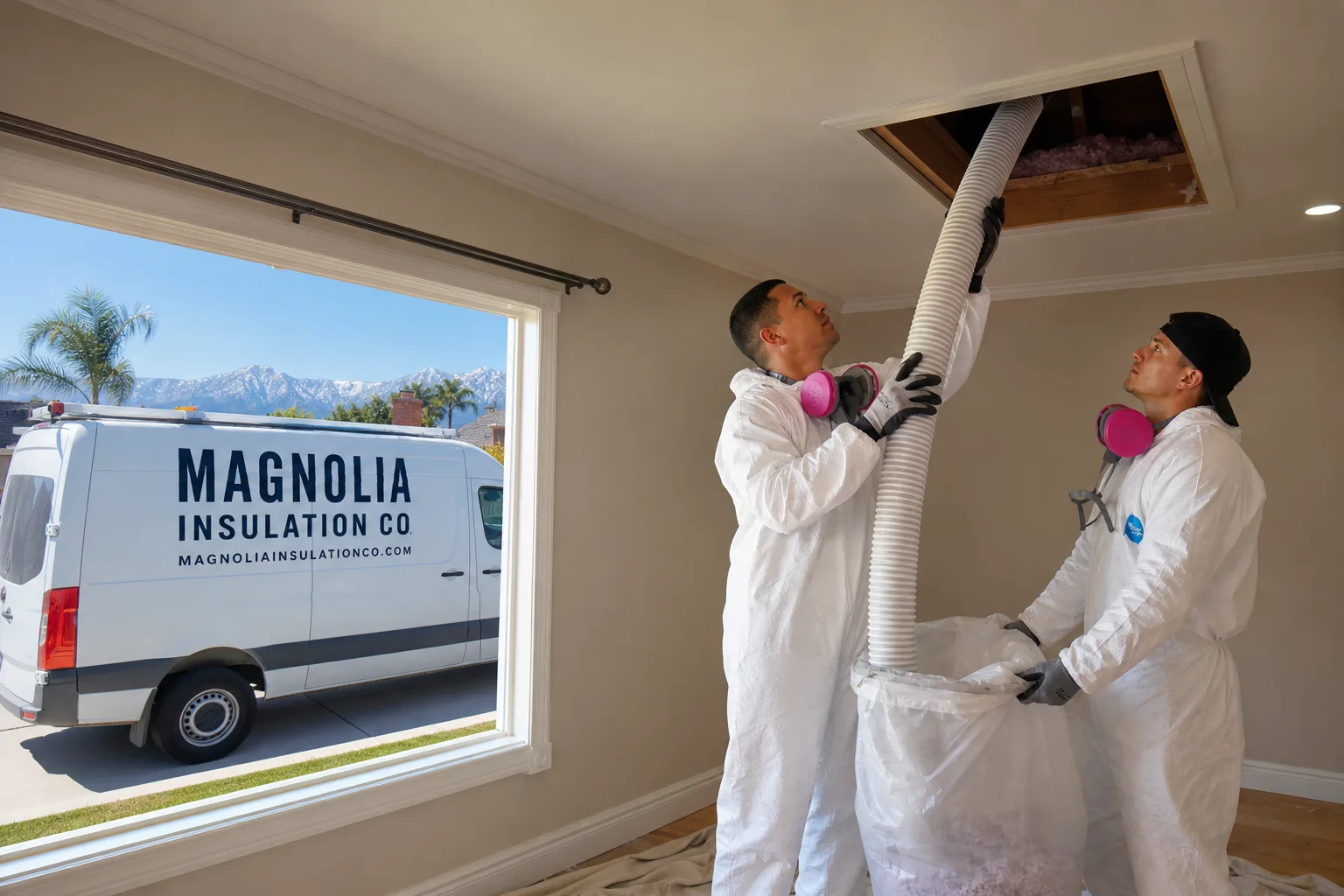
Fast, Reliable Spray Foam Insulation Across San Antonio Heights
Spray foam insulation in San Antonio Heights typically runs $2.50 to $6.50 per square foot for open-cell and $3.50 to $9.00 for closed-cell, with most full attic projects landing between $4,800 and $14,000 depending on square footage and access. We respond to San Antonio Heights calls within 90 minutes most days, because our crews stage out of Rancho Cucamonga and know the 210 corridor well. But this hillside community above Upland isn’t a flatland job site, and the insulation decisions you make here carry weight that a mid-valley home never faces. Call (866) 464-1714 and you’ll talk to someone who understands why your attic is different from one ten minutes downhill.
Why Magnolia Insulation Co Is San Antonio Heights’s Preferred Spray Foam Insulation Company
We’ve worked 91784 long enough to recognize the pattern: mid-century ranch homes with open eaves, balloon-framed walls, and attic cavities that have been collecting Santa Ana dust since the Eisenhower administration. Homeowners here don’t just want lower cooling bills, they want a thermal envelope that holds against cold winter nights at 1,800 feet and refuses to become kindling when fire season hits. That’s the standard we build to.
Our reputation in San Antonio Heights comes from doing the unglamorous work right: sealing eave lines before spraying, verifying ventilation paths after foam goes in, and telling a homeowner honestly when closed-cell on a roof deck makes sense versus when open-cell on an attic floor is the better spend. Glen Pacheco, who leads our crews, has walked enough hillside attics in this community to know where the dust piles first and where the embers find their way in.
We’re licensed and insured, and our work in San Antonio Heights carries the same warranty we offer across the Inland Empire. When you call, you’ll get a straight answer about timing and a real estimate, not a pitch.
Spray Foam Attic Insulation in San Antonio Heights
Spray Foam Attic Insulation in San Antonio Heights is our most requested service, and for good reason: the open-eave soffits common on 1950s to 1970s hillside homes let wind-driven dust and embers into attic spaces that few flatland crews ever see. The elevation means colder winter nights than Upland or Claremont, while the summer sun beats the roof deck relentlessly. An unsealed attic in this microclimate is a hole in your utility bill twice over.
Attic Floor Air-Sealing and Open-Cell Foam
For most ranch homes in San Antonio Heights, the right move is sealing the attic floor with open-cell Icynene or Demilec spray foam. We remove or address the compromised fiberglass that’s been pulled back from the soffit line, install ember-resistant baffles where the vents meet the eave, and spray a continuous air barrier across the attic floor. Done correctly, this closes the pathway where Santa Ana winds push grit into your house and hot air out of it.
Costs for this scope typically land between $5,000 and $9,500 depending on attic size, and the difference shows up on the next winter bill, not some future promise.
Roof Deck and Vented Attic Alternatives
Hillside homes with cathedral ceilings or finished attic spaces sometimes need closed-cell foam applied to the roof deck itself. That’s a bigger material cost, in the $9,000 to $14,000 range for a typical San Antonio Heights roof, but it moves the thermal boundary to the roofline and turns the attic into semi-conditioned space. We’ll tell you plainly if your structure benefits from this or if attic-floor foam gets you 90 percent of the result for half the spend.
Spray Foam Wall Insulation in San Antonio Heights
Spray Foam Wall Insulation in San Antonio Heights is the answer for the custom ranch and hillside homes whose original construction predates modern energy codes. Many 1960s homes here have empty wall cavities or thin fiberglass batts that have settled over fifty years. Open-cell foam injected into exterior walls fills those gaps completely, cutting drafts and quieting the house against wind.
Drill-and-Fill Wall Retrofit
For finished homes, we use a drill-and-fill method: small access holes through drywall or stucco, foam injected into each stud bay, then matched patching. It’s the least disruptive way to bring a 1962 ranch in San Antonio Heights up to modern thermal performance without tearing out drywall. Expect $3.50 to $6.00 per square foot of wall area, and expect us to check the eave line above before we spray.
Open-Stud New Construction and Gut Rehabs
When walls are open during a remodel or addition, we spray directly between studs, filling every void and sealing wiring and plumbing penetrations as we go. For San Antonio Heights additions that face the Santa Ana corridor, this is the difference between a room that holds temperature and one that breathes through the walls. Closed-cell adds structural rigidity and a vapor barrier, which matters on hillsides where wind-driven rain hits the west-facing elevation.
Trusted Brands We Service in San Antonio Heights
We’re authorized installers for eight insulation manufacturers, and for Spray Foam Insulation work we rely most on Icynene and Demilec, two of the most recognized open-cell and closed-cell foam systems in North America. We also carry GreenFiber cellulose and Owens Corning batts for blended approaches, so a San Antonio Heights attic that needs foam at the eave line but cellulose over the main floor gets exactly that, not a forced one-product solution. Parts and materials for San Antonio Heights jobs are stocked in our Rancho Cucamonga yard, which keeps turnaround short.
Common Spray Foam Insulation Problems We See in San Antonio Heights Homes
- Foam sprayed over open-eave soffits without baffling. This is the biggest one in San Antonio Heights. A contractor seals the attic floor but ignores the vented eave, leaving a gap where Santa Ana winds push embers and dust straight into the attic. The foam does its thermal job, but the fire-hardening step never happened.
- Foam applied without resolving existing insulation failures. We see attics where the original 1960s fiberglass has slumped or been pulled away from the eave line, and a crew sprays directly over it. The air leak at the soffit remains, condensation forms, and performance craters.
- Inadequate ventilation after foam application. San Antonio Heights gets intense summer sun, and an attic that’s sealed tight without a ventilation plan traps heat. That shortens roofing material life and pushes heat into the living space below. We verify airflow after every attic job.
- Closed-cell used where open-cell would suffice. Some crews upsell closed-cell on attic floors when open-cell does the job for hundreds less per square foot. On wall cavities and roof decks, closed-cell earns its cost. On a flat attic floor in a 1968 ranch, it often doesn’t.
Pricing for Spray Foam Insulation in San Antonio Heights, CA
A full attic-floor air-seal and open-cell spray foam in San Antonio Heights runs $5,000 to $9,500 for most ranch homes between 1,200 and 2,400 square feet. Wall retrofits land at $3.50 to $6.00 per square foot of wall area. Roof deck closed-cell work starts around $9,000 and climbs with roof complexity, especially on hillside lots with steep pitches. Access matters here: a 1963 hillside home with a narrow pull-down attic stair takes longer than a 1980s rebuild with a full staircase. Estimates are free, and we’ll give you a written number before any work begins. Call (866) 464-1714 to schedule a walkthrough.
We Also Serve Cities Near San Antonio Heights
Our crews work throughout the eastern San Gabriel foothills, including Upland, Claremont, Rancho Cucamonga, and Montclair. If you’re in San Antonio Heights proper or just down the hill, the same team and the same eight-brand lineup is available. You can read more about our work across the area on our San Antonio Heights page.
Serving San Antonio Heights, CA — Our Local Coverage Area
We’re based in the San Antonio Heights area and know this community well. Use the map below to see our service coverage — if you’re nearby, we can almost certainly help.
FAQs About Spray Foam Insulation in San Antonio Heights
Spray foam itself is not a fire barrier, but the air-sealing it provides is a critical ember-defense step for San Antonio Heights homes. Your open-eave soffits are the entry point where wind-driven embers reach the attic, and sealing those gaps while installing ember-resistant baffles meaningfully reduces intrusion risk. We always pair foam application with eave-line detailing on hillside homes. Call (866) 464-1714 for an assessment of your specific roofline.
Yes, in most cases, and that’s exactly what we did on a 1960s custom ranch in the San Antonio Heights hillside area recently. The home’s open-eave construction had left the original low-density insulation pulled away from the soffit line. Our crew removed the compromised material at the eave, installed ember-resistant soffit baffles, sealed the attic floor with Icynene spray foam, and verified ventilation afterward. The original center-of-attic insulation stayed in place where it was performing. Call us at (866) 464-1714 to talk through your attic’s specific layout.
Spray foam handles the San Antonio Heights temperature range well because it creates a continuous air barrier, not just a thermal layer. Your 1,500 to 2,000-foot elevation means winter nights dip colder than Upland or Claremont below, and summer sun on the roof deck is intense. Foam stops the air exchange that drives most heat loss and gain, so the indoor temperature stays steadier. Open-cell and closed-cell both do this; the right choice depends on your structure. Estimates are free, call (866) 464-1714.
We use both open-cell and closed-cell foam depending on the application, drawing from Icynene and Demilec systems. For attic floors in San Antonio Heights ranch homes, open-cell is usually the right call: it air-seals effectively and costs less. For roof decks, walls on windward elevations, and areas needing a vapor barrier, closed-cell performs better. We don’t push one product; we recommend based on your home’s construction and exposure. Call (866) 464-1714 and we’ll explain which fits your hillside home.
Most spray foam insulation retrofits in San Antonio Heights fall under County of San Bernardino building codes, and a permit is typically required when the work changes the building’s thermal boundary or touches structural elements. Minor air-sealing on attic floors often doesn’t trigger a permit, but roof deck foam and wall retrofits sometimes do. We’ll tell you what applies to your specific project before we schedule anything. Call (866) 464-1714 for a straight answer on your home.
Written by Glen Pacheco, Owner at Magnolia Insulation Co, serving San Antonio Heights and the Inland Empire foothills.