
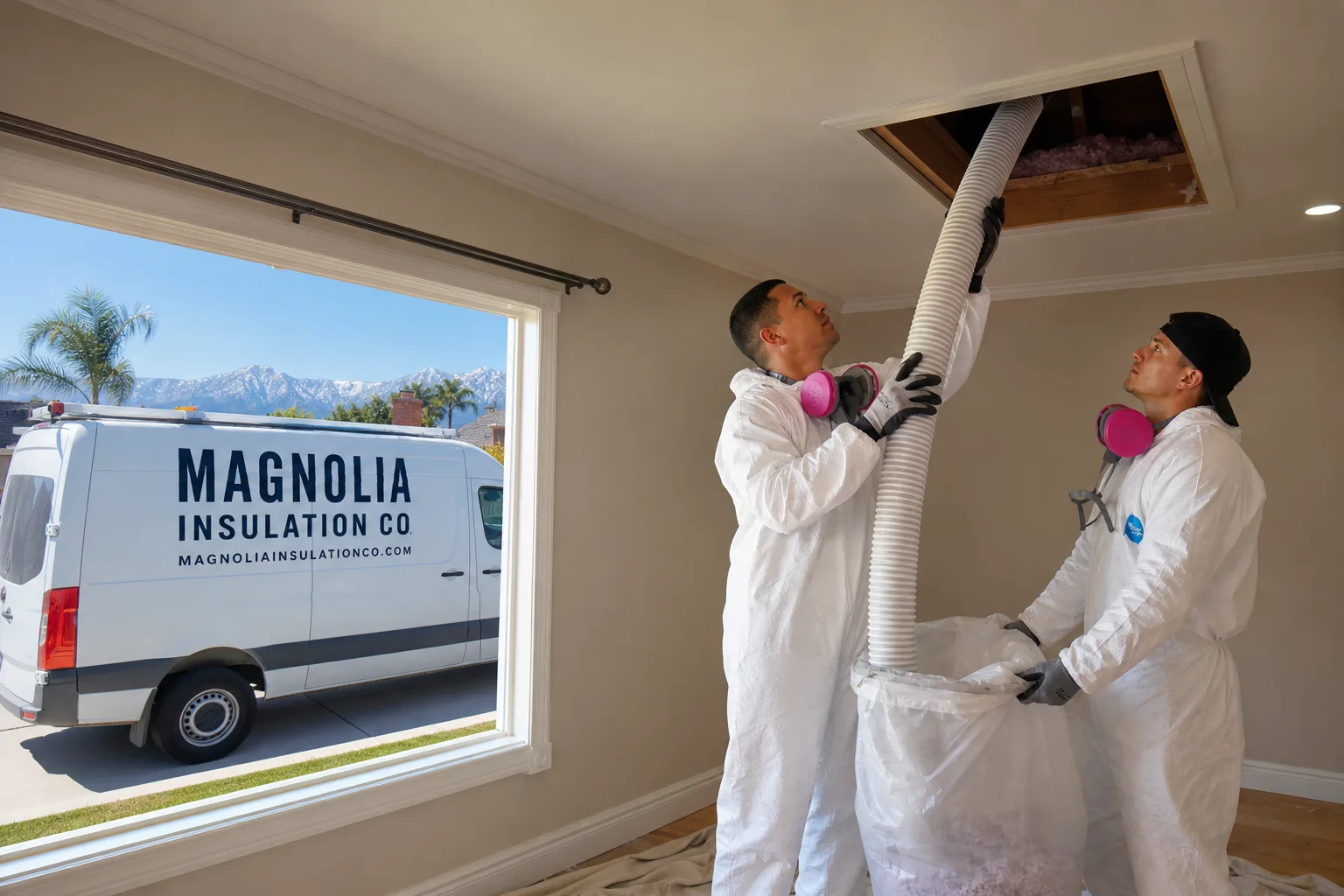
Fast, Reliable Spray Foam Insulation Across Running Springs
Spray foam insulation in Running Springs, CA typically costs $2.50 to $6.50 per board foot for open-cell and $3.50 to $8.50 per board foot for closed-cell, with most full attic or rim joist projects landing between $2,800 and $9,500. We know those ranges matter because Running Springs homes are unlike anything at lower elevation. At 6,000+ feet, your insulation is not a summer cooling strategy; it’s your primary defense against snow load, freeze-thaw cycles, and wind that finds every gap in an old mountain cabin. Call us at (866) 464-1714 and we’ll give you an exact number before any work begins.
Magnolia Insulation Co serves all of the 92382 zip code, from the ridgeline properties above Highway 18 down to the older cabins off Live Oak Drive. We run crews up the mountain weekly, and we respond to Running Springs calls faster than most flatland contractors because we actually plan routes around the 18 and 330, not as an afterthought. Glen Pacheco built this company around a simple idea: recommend the right insulation for the specific house, not whatever product is sitting in the warehouse.
Key Takeaways:
- Running Springs spray foam work runs $2,800 to $9,500 for typical attic or rim joist projects
- Closed-cell foam is usually the right call here for snow load and freeze-thaw protection
- We service Running Springs weekly, including emergency calls during winter storm cycles
- Free estimates, upfront pricing, and the right brand recommendation per application
Why Magnolia Insulation Co Is Running Springs’s Preferred Spray Foam Insulation Company
We’re not a one-product shop that shows up with a single foam system and calls it a day. Magnolia carries eight of the industry’s most respected insulation brands, including Icynene and Demilec spray foam lines. That means when we walk into a Running Springs crawlspace, we’re not forcing a product into a house it was never designed for. We’re matching the foam to the structure, the elevation, and your actual winter conditions.
Local experience matters up here. Running Springs is not the Inland Empire, and Spray Foam Insulation applied by a crew that has never worked above 4,000 feet often fails in ways homeowners don’t discover until the first big melt. We have seen it repeatedly: foam applied too thin over old attic penetrations, rim joists left unsprayed in pier-and-beam crawlspaces, condensation forming on north-facing slopes where snow lingers for weeks. Glen Pacheco and our field teams know these failure modes because we have corrected them in Running Springs homes.
If you live in Running Springs, we already know your house’s likely construction type: an older mountain cabin or mid-century second home, probably on pier-and-beam or slab-on-grade, probably with minimal original insulation and an unsealed attic that has been leaking heat every winter since it was built. That’s not a guess. That’s the housing stock. And we know exactly what to do about it.
Spray Foam Wall Insulation in Running Springs
Spray foam wall insulation in Running Springs is the highest-impact retrofit for older mountain homes where walls were originally built with nothing more than newspaper, sawdust, or thin fiberglass that has long since settled. At 6,000 feet, under-insulated walls mean frozen pipes, constant heat loss, and a furnace that never stops running from November through March. On pier-and-beam cabins, the wall cavities and band areas are where winter wind does the most damage.
A typical spray foam wall insulation project in Running Springs runs $3,200 to $8,400 depending on square footage, cavity depth, and whether we’re working from the interior or exterior. We see homes off Crestline Road and along Glenview Drive where the original stud bays are barely R-7. That’s not sufficient for a mountain climate, and the homeowners feel it every single storm cycle.
Freeze-Thaw Protection for Wall Cavities
On north-facing slopes above town, snow sits against exterior walls for weeks. When the sun hits those walls mid-day and temperatures drop below freezing at night, moisture migrates into any gap in the insulation envelope. Closed-cell spray foam, properly applied, creates an air barrier and a vapor retarder in one pass, which is why we specify it for most Running Springs wall applications.
Retrofitting Without Gutting the Cabin
Many Running Springs homeowners ask if we can insulate walls without tearing out drywall. The answer is usually yes. We can apply foam from the exterior behind removed siding, or we can work from the interior using injection methods on closed cavities. The right approach depends on your specific structure, and we’ll walk you through the trade-offs before you spend a dime.
Rim Joist Spray Foam in Running Springs
Rim joist spray foam in Running Springs is the single most overlooked insulation job in pier-and-beam mountain construction, and it is also one of the most consequential. Your rim joist is the band of wood that sits on top of the foundation wall, where the floor framing meets the outside. In most Running Springs cabins, those rim joists were never insulated at all, which means winter wind and snowmelt drive directly into the floor cavity and freeze pipes.
Rim joist spray foam in Running Springs typically costs $1,800 to $4,200 for a full cabin perimeter. That price covers the foam, the prep, and the air-sealing of the band area. It is one of the fastest payback projects we do in the mountain communities, because the heat loss through an unsprayed rim joist is enormous once temperatures drop into the teens at night.
Sealing Against Wind and Snowmelt
On a pier-and-beam cabin off Crestline Road, we found the original fiberglass batts sagging and rim joists completely unsealed, letting driving wind and snowmelt push into the crawlspace. We removed the failing batts, applied Icynene closed-cell spray foam to the rim joists and band area, and sealed the attic plane. The homeowner reported warmer floors and no more pipe-freeze worries during the next storm cycle. That’s the outcome we aim for on every Running Springs job.
Pipe Freeze Prevention
Pipes in Running Springs crawlspaces freeze because of air movement, not just cold temperatures. When wind pushes through an unsprayed rim joist, it strips heat away from the plumbing lines. Closed-cell foam stops that air movement completely. If you’ve already had one freeze event, you’re statistically far more likely to have another unless the air-sealing is corrected.
Trusted Brands We Service in Running Springs
Magnolia Insulation Co installs both Icynene and Demilec spray foam systems, two of the most technically advanced foam platforms available to professional contractors. We also carry GreenFiber cellulose and Rockwool mineral wool for Running Springs homeowners who want fire resistance or sound damping alongside thermal performance. Our approach is simple: eight brands, one recommendation. We pick the right material for your specific home, and we never push a product just because it’s what’s on the truck.
For Running Springs customers, we keep the most commonly needed foam formulations and air-sealing materials stocked for mountain-specific applications, so we’re not making five trips down the hill for supplies. That keeps your project moving and keeps our response times short when the weather turns.
Common Spray Foam Insulation Problems We See in Running Springs Homes
- Closed-cell foam applied too thin over unsealed attic penetrations. At 6,000 feet, even a quarter-inch gap around a vent pipe or electrical chase lets freeze-thaw moisture migrate through and rot the roof deck over time.
- Rim joists left unsprayed in pier-and-beam crawlspaces. Winter wind and snowmelt drive into the floor cavity, and the first casualty is usually the plumbing. We find frozen-pipe damage behind this failure mode more than any other in Running Springs.
- Foam installed over failing legacy insulation without addressing air barriers. On north-facing slopes where snow sits for weeks, this creates condensation points inside the wall assembly, leading to mold and rot that flatland crews never design for.
- Open-cell foam used where closed-cell was required. Open-cell has its place, but in a Running Springs roof deck or crawlspace that sees standing snow and sub-freezing nights, closed-cell’s density and moisture resistance are often non-negotiable.
Pricing for Spray Foam Insulation in Running Springs, CA
For Running Springs, spray foam insulation pricing breaks down like this: open-cell foam runs $2.50 to $6.50 per board foot, closed-cell runs $3.50 to $8.50 per board foot, rim joist work lands between $1,800 and $4,200 for a full perimeter, and full attic or wall retrofit projects typically fall between $2,800 and $9,500. The biggest variables are square footage, access difficulty on steep lots, and whether we’re removing old insulation before spraying. Mountain access does add some cost versus flatland work, but it’s modest, and we’ll itemize it on every estimate. Call (866) 464-1714 for a free, specific quote for your Running Springs home. Estimates are free, and we do not charge for the drive up the hill.
We Also Serve Cities Near Running Springs
Our crews regularly work in Running Springs and the surrounding mountain and foothill communities. We also serve Lake Arrowhead, Highland, Mentone, and Crestline, so if you have a rental cabin or family property in any of those areas, we can handle the insulation work on the same route. Same crew, same standards, same upfront pricing.
Serving Running Springs, CA — Our Local Coverage Area
We’re based in the Running Springs area and know this community well. Use the map below to see our service coverage — if you’re nearby, we can almost certainly help.
FAQs About Spray Foam Insulation in Running Springs
Yes. Ice dams form when warm attic air melts snow on the roof, and the meltwater refreezes at the eaves. Closed-cell spray foam applied to your attic plane stops that warm air from reaching the roof deck in the first place, which dramatically reduces ice dam formation on Running Springs roofs. Call (866) 464-1714 and we’ll assess your attic and give you an honest answer about whether foam is the right fix for your specific roof.
In most cases, no. The failing fiberglass needs to come out before foam goes in, because leaving it in place creates air gaps and condensation points. We remove old batts as part of the job, and we’ll handle the disposal. For a rim joist application specifically, the old fiberglass in the band area is always removed before we spray.
Closed-cell spray foam is the only insulation we recommend for north-facing Running Springs homes where snow sits against the structure for extended periods. Its density resists moisture migration, and when installed with proper air-sealing at every penetration, it prevents the freeze-thaw moisture that rots roof decks and wall sheathing. Open-cell foam is not appropriate for this condition.
Yes, and older Running Springs cabins are precisely where spray foam delivers the biggest measurable difference. These homes were rarely built with performance insulation, and the air leakage through unsealed attics, walls, and rim joists is enormous. We regularly see utility bills drop 30% to 50% after a full foam retrofit, and the comfort change is immediate. Call us at (866) 464-1714 for specifics on your cabin.
We install both Icynene and Demilec spray foam systems, and we recommend the right one per application. For Running Springs roof decks and crawlspaces that see standing snow and sub-freezing nights, we usually specify a closed-cell formulation from one of those two platforms. For interior sound-damping applications, open-cell is often the better fit. Your estimate will name the exact product we recommend and the reason for it.
If you’re tired of cold floors, frozen pipes, or utility bills that climb every winter, call Magnolia Insulation Co at (866) 464-1714. We’ll come up the mountain, look at your specific home, and tell you exactly what it needs and what it costs. No push, no script, just building-science basics and plain English answers.
Written by Glen Pacheco, Owner at Magnolia Insulation Co, serving Running Springs and the San Bernardino Mountain communities.