
Fast, Reliable Spray Foam Insulation Across Home Gardens
Spray foam insulation in Home Gardens usually runs between $2,800 and $7,500 for a full attic job, with wall injection projects on stucco tract homes starting around $3,200. If you’re looking for Reflectix repair in Home Gardens, we can assess whether it’s the right fit alongside your foam insulation plan. Most Home Gardens homeowners call us when their AC has been running nonstop since June and the upstairs still won’t drop below 80°F. If that sounds familiar, you’re not dealing with a bad air conditioner. You’re dealing with attic temperatures over 150°F and walls that were never insulated properly in the first place. Our crew works throughout the 92879 zip code every week, and we can usually have a technician at your Home Gardens property within 24 to 48 hours for an assessment. Call (866) 464-1714 and we’ll walk you through what’s actually going on in your attic and walls.
Key Takeaways
- Home Gardens summers regularly push attic temps past 150°F, which destroys old fiberglass batts and forces AC systems to run constantly.
- Spray foam is the only practical way to add R-value to empty wall cavities in slab-on-grade 1970s stucco homes without tearing out drywall.
- Closed-cell foam does double duty here: it insulates and it seals against the dust that Santa Ana winds push through framing gaps.
- Magnolia Insulation Co carries both Icynene and Demilec spray foam systems, so the foam selection matches the specific job, not our inventory.
Why Magnolia Insulation Co Is Home Gardens’s Preferred Spray Foam Insulation Company
Home Gardens keeps us busy for a specific reason: the housing stock here was built for a different climate than the one we’ve got now. Those 1970s and early 80s stucco tract homes off Magnolia Avenue and surrounding streets were framed when energy was cheap and insulation was an afterthought. Today, the same homes sit through 100°F+ afternoons from June through September, and the original R-11 attic batts simply can’t keep up. We’ve been through enough Home Gardens attics to know exactly what we’ll find before we even open the hatch: sagging, compressed fiberglass, gaps around HVAC equipment platforms, and dust trails from the Santa Ana corridor winds. That local familiarity means we diagnose faster and quote more accurately than a company driving in from outside the area.
Our Spray Foam Insulation team has worked on dozens of homes across Home Gardens, from tight one-story ranchers to larger two-story additions. Homeowners here consistently tell us the same thing: they want someone who understands why their house won’t cool down, not someone reading a script about R-values. That’s how we run every job. Glen Pacheco, who leads our crews, has built the company on a simple principle: recommend the right material for the specific structure, whether that’s open-cell foam for a vented attic, closed-cell for a roof deck, or injection foam for empty stucco wall cavities. We serve all of Home Gardens, including neighborhoods north of Magnolia Avenue and the tracts east toward the Santa Ana River corridor.
Response time to Home Gardens is typically next-day for estimates, and we can schedule most retrofit jobs within one to two weeks depending on scope. Every estimate is free, and every recommendation comes with a plain-English explanation of why we’re suggesting a particular foam type and thickness.
Spray Foam Insulation Contractors in Home Gardens
Spray Foam Insulation Contractors in Home Gardens handle jobs that most general insulation companies won’t touch: tight attics with low-slope roofs, wall cavities behind stucco that have never held insulation, and rim joist bays that leak conditioned air into the crawlspace or slab edge. When a Home Gardens homeowner calls us, the conversation usually starts with a comfort problem: one bedroom that’s always hot, an AC that cycles without ever satisfying the thermostat, or a utility bill that doubled since the HVAC was replaced. The fix often has less to do with the equipment and more to do with the thermal envelope around it.
Closed-Cell Roof Deck Application
For Home Gardens homes with pitched, low-slope or flat roofs and attached garages, applying closed-cell foam directly to the underside of the roof deck converts a vented attic into a semi-conditioned space. That drops attic temperatures dramatically, which means the ductwork running through that space isn’t trying to push 55°F air through a 150°F oven. This is the single highest-impact retrofit we perform in the 92879 zip code.
Wall Cavity Injection for Slab Homes
Most Home Gardens tract homes sit on slab-on-grade foundations, which means there’s no crawlspace access to the exterior walls. The original builder counted on the stucco and drywall alone for thermal control, and the result is wall cavities that are empty or barely filled. Injection foam, applied through small holes drilled in the exterior stucco, is the only practical way to get real R-value into those walls without gutting the house.
Spray Foam Attic Insulation in Home Gardens
Spray Foam Attic Insulation in Home Gardens is the work we do most often, because the attics in this community were under-insulated from day one and decades of Inland Empire heat have made things worse. Original R-11 batts sag under their own weight, compress against the drywall, and leave convection loops that pull superheated attic air down toward the living space. When a new HVAC unit goes in, installers often shift or remove batts and never put them back right. The result is bare drywall ceilings that radiate heat into the house all afternoon.
Air Sealing as Part of the Job
In Home Gardens, sealing matters as much as R-value. The late-afternoon winds through the Santa Ana River corridor drive dust and attic debris into any open gap around top plates, wire penetrations, and ceiling boxes. Closed-cell foam seals those gaps permanently. It’s not just about insulation; it’s about keeping the dust outside where it belongs.
Removing and Replacing Legacy Batts
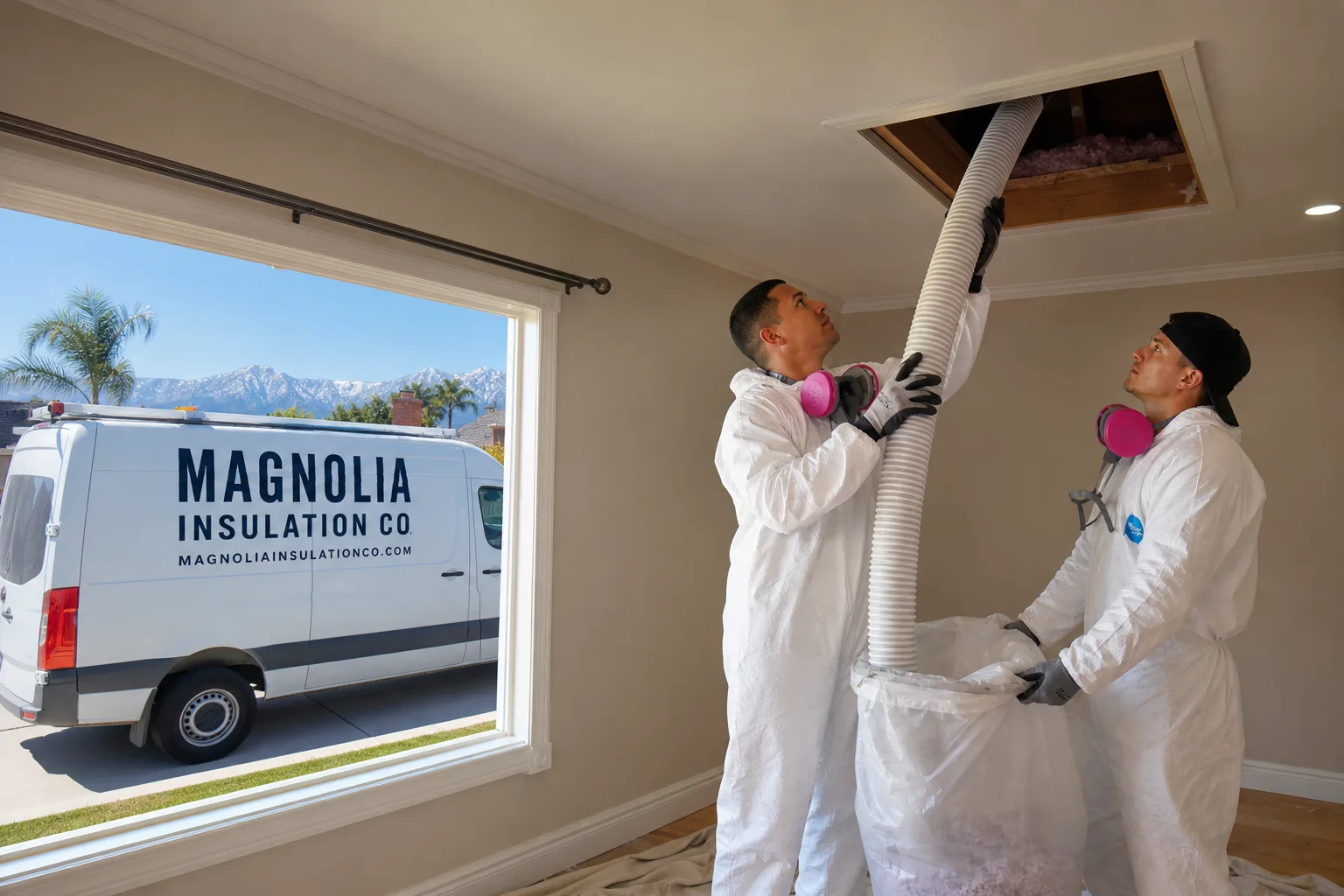
We don’t spray over failed insulation. The old fiberglass comes out first, down to the drywall, and then we inspect the framing and wiring before applying foam. Home Gardens homeowners are often surprised at how much dust and pest debris we vacuum out of attics that haven’t been opened in 20 years.
Trusted Brands We Service in Home Gardens
We’re not tied to a single foam manufacturer, and that matters in Home Gardens where every job presents a slightly different problem. Our crews are authorized installers for both Icynene and Demilec spray foam systems, which means we can choose open-cell or closed-cell based on what the application actually calls for, not what our supplier happens to stock. We also work with CertainTeed and GreenFiber products when a Home Gardens homeowner wants a hybrid approach or a recycled-content option for part of the project. Because we keep a full material inventory, we don’t have to special-order foam for common Home Gardens retrofit scenarios. That keeps turnaround tight and pricing predictable.
Common Spray Foam Insulation Problems We See in Home Gardens Homes
- Sagging and compressed original batts: R-11 and R-13 fiberglass from the 1970s and 80s loses loft under 150°F attic heat, leaving entire sections of ceiling with effectively no insulation. The AC runs nonstop and the thermostat still climbs after 3 p.m.
- Gaps around replacement HVAC systems: New furnaces and air handlers are smaller than the originals, which leaves open equipment platforms and disconnected duct connections. Those gaps pull in hot attic air in summer, along with dust and pest intrusion during Santa Ana wind events.
- Empty wall cavities on slab-on-grade homes: With no crawlspace to work from, the original builder left wall insulation out entirely. The stucco and drywall don’t stop radiant heat gain, and the rooms along the western exposure become unusable in the late afternoon.
- Open soffit and rim joist penetrations: On homes with attached garages and low-slope roofs, we regularly find light and air moving freely through rim joist bays where the floor framing meets the garage wall. This is a major source of unconditioned air infiltration in Home Gardens tract homes.
Pricing for Spray Foam Insulation in Home Gardens, CA
Here’s what Home Gardens homeowners can expect on current pricing. A typical attic retrofit with closed-cell foam on the roof deck runs $4,800 to $7,500 for a 1,200 to 1,800 square foot home. Wall cavity injection into empty stucco walls generally lands between $3,200 and $5,800 depending on the number of exterior walls and how much drilling access is available. Rim joist sealing in an attached garage is smaller, usually $900 to $2,100. Open-cell foam in a vented attic costs less per board foot than closed-cell, but it doesn’t air seal the way closed-cell does, so the right call depends on your specific roof and duct configuration. Every Home Gardens estimate includes a written scope of work and a flat price before we start. No hourly billing, no change orders halfway through. Call (866) 464-1714 for a free estimate and we’ll give you numbers tailored to your house, not a generic range.
We Also Serve Cities Near Home Gardens
Magnolia Insulation Co runs crews throughout western Riverside County, and we routinely handle projects in Spray Foam Insulation in Home Gardens and the surrounding communities. If you’re in Corona, Eastvale, Norco, or El Cerrito Corona, the same team and the same pricing structure apply. Most nearby jobs are scheduled within a week of the initial estimate.
Serving Home Gardens, CA — Our Local Coverage Area
We’re based in the Home Gardens area and know this community well. Use the map below to see our service coverage — if you’re nearby, we can almost certainly help.
FAQs About Spray Foam Insulation in Home Gardens
Yes. Closed-cell spray foam works extremely well on low-slope and flat roof decks, which are common throughout Home Gardens. The foam is applied directly to the underside of the roof sheathing, creating a thermal and air barrier that dramatically reduces attic heat gain. For most 1970s tract homes in the 92879 zip code, this is the single most effective retrofit available. Call (866) 464-1714 and we’ll confirm your roof configuration qualifies.
Yes, and this is one of the most common jobs we perform in Home Gardens. Since slab-on-grade construction leaves no crawlspace access to the exterior walls, we inject foam through small holes drilled in the stucco from the outside. It’s the only practical way to add R-value to those wall cavities without tearing out drywall or doing a full remodel. The holes get patched and the stucco is textured back to match.
Closed-cell spray foam maintains its R-value under the kind of heat Home Gardens sees every summer, while fiberglass batts lose loft and effectiveness as they age and as temperatures climb. A sealed attic with foam on the roof deck typically runs 25 to 35°F cooler than a vented attic with legacy batts. That translates directly to shorter AC cycles and a thermostat that actually holds its setpoint. For exact savings, call (866) 464-1714 and ask for a Home Gardens attic assessment.
Yes. The Santa Ana winds in late afternoon push dust and debris through any gap in the building envelope, and Home Gardens tract homes have plenty of those gaps around top plates, wire penetrations, and recessed lights. Closed-cell foam seals those openings completely. Many Home Gardens homeowners tell us the dust reduction alone was worth the cost of the job. Estimates are free, so call (866) 464-1714 to see if your home qualifies.
We install Icynene and Demilec spray foam systems, and the choice between them depends on the specific application: open-cell versus closed-cell, roof deck versus wall cavity, new construction versus retrofit. Because we carry both lines, we’re not forcing one product into every Home Gardens job. Our recommendation is based on the condition of your specific home, not our inventory levels. Call (866) 464-1714 and we’ll explain the difference in plain English.
One More Thing Home Gardens Homeowners Should Know
Here’s the piece most insulation companies won’t tell you: in Home Gardens, the empty wall cavities in your slab-on-grade tract home are the biggest source of heat gain you never see. The original builders relied on the stucco and drywall alone for thermal control, and in this climate, that’s not enough. Spray foam injected through the exterior stucco is the only way to get true R-value into those walls without tearing the house apart. And the Santa Ana winds make sealing just as critical as insulation. We recently foamed the attic of a 1978 stucco tract home off Magnolia Avenue where the original R-11 batts had collapsed around a replacement HVAC unit, leaving bare drywall that hit 150°F by mid-afternoon. After vacuuming out the old fiberglass and sealing every top plate and wire penetration, we applied 2 inches of closed-cell spray foam to the roof deck, which knocked the attic temperature down by 30°F by the next heat wave and stopped the dust that had been blowing through the gaps. That’s what we do in Home Gardens. If your house is fighting the heat and losing, call (866) 464-1714 and let’s figure out where the envelope is leaking. Estimates are free, and we’ll give you a straight answer about what’s wrong and what it costs to fix.
Written by Glen Pacheco, Owner at Magnolia Insulation Co, serving Home Gardens and the surrounding Inland Empire communities.