
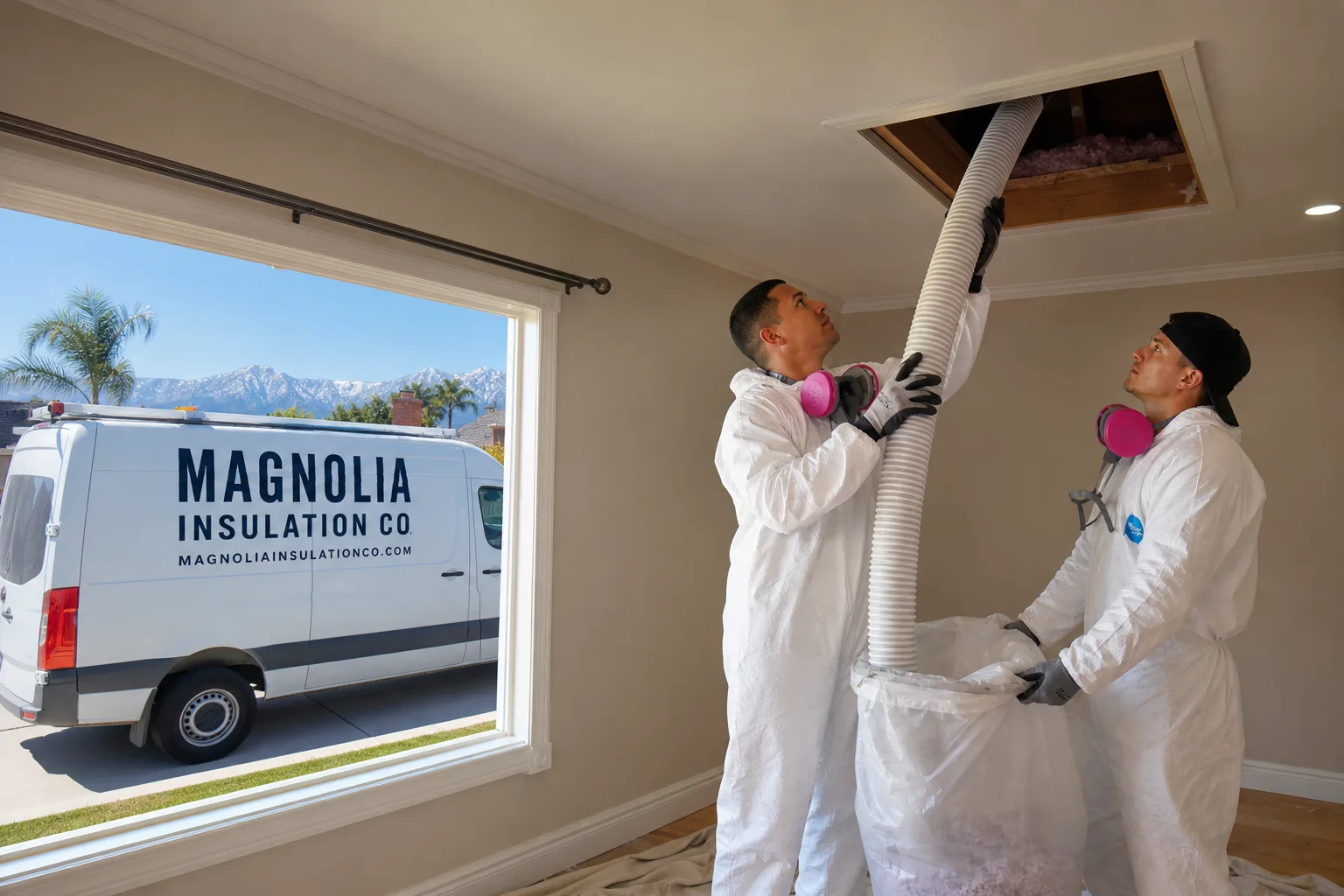
Fast, Reliable Spray Foam Insulation Across El Cerrito Corona
If your El Cerrito Corona attic turns into an oven every August, spray foam insulation is usually the strongest fix for the heat that settles into your upstairs rooms. We handle open-cell and closed-cell spray foam jobs throughout the 92881 zip code, from the flatland tracts near Ontario Avenue up into the hillside streets off Foothill Parkway. Most El Cerrito Corona homes we see were built between the 1970s and early 2000s, and their attics were never designed for the 140 – 160°F heat they actually absorb. Call us at (866) 464-1714 and we’ll tell you what your attic needs, not what we’re trying to unload.
Glen Pacheco leads our crews, and he’ll be the first to tell you that spray foam in El Cerrito Corona is a different animal than spray foam in Corona or Eastvale. The hillside exposure, the radiant heat loading, and the way older tract homes were framed all change what works.
Why Magnolia Insulation Co Is El Cerrito Corona’s Preferred Spray Foam Insulation Company
We’ve spent enough time in 92881 attics to recognize the pattern before we even climb the ladder. Original R-11 batts, collapsed and gray with dust. Sun-baked duct insulation crumbling off the flex lines. And, increasingly, failed open-cell foam that a previous contractor sprayed directly onto the attic ceiling without accounting for the heat. When you live in El Cerrito Corona, that heat is the whole conversation.
What keeps homeowners calling us is that we don’t push one product. Magnolia Insulation Co carries eight major insulation brands, including Icynene and Demilec spray foam systems, Rockwool mineral wool, and GreenFiber cellulose. That matters here because the right call for a 150°F hillside attic is often closed-cell foam on the roof deck, not open-cell on the ceiling. If a company only sells one foam line, you’ll get that foam whether it fits or not. We recommend per application.
El Cerrito Corona homeowners also tell us they appreciate that we show up when we say we will. Our crews route through the 91 and 15 corridors, so a call from the 92881 side of Corona usually gets a same-week visit, often faster. And because we work this area regularly, we already know the street patterns, the roof pitches, and the age of the housing stock on your block.
Written by Glen Pacheco, Owner at Magnolia Insulation Co. Our Spray Foam Insulation team has worked these hillside tracts and flatland neighborhoods for years, and we treat every attic like it’s going to be inspected by someone who knows building science.
Closed Cell Spray Foam Insulation in El Cerrito Corona
Closed Cell Spray Foam Insulation is the workhorse for El Cerrito Corona attics that bake in the 92881 summer heat. It’s a dense, rigid foam that cures into a sealed layer with an R-value around R-6.5 to R-7 per inch, and because it’s a vapor barrier, it doesn’t absorb moisture the way open-cell can. In a hillside tract home where the attic hits 150°F by 3 p.m., closed-cell on the underside of the roof deck creates a thermal break that stops the heat before it ever gets into the living space below.
A typical closed-cell roof deck job in El Cerrito Corona runs $4.50 to $7.50 per board foot installed, which usually lands between $6,000 and $14,000 depending on square footage and access. That’s real money, but it’s the option we recommend most often up in the hills where the sun sits on the roof all afternoon.
Roof Deck Applications for Hillside Homes
When we spray closed-cell directly onto the roof deck, the attic becomes conditioned space. That changes the math for your HVAC system, which is often sitting up there in the heat. Ductwork that used to run through a 150°F attic now sits in an 80°F space, and conditioned air stops losing temperature before it reaches the bedroom.
For the Santiago Road and Foothill Parkway hillside homes especially, this is the fix that finally cools down upstairs rooms that never quite worked.
When Closed-Cell Beats Open-Cell in El Cerrito Corona
If the attic has any ventilation limitations or if the roof framing shows signs of past moisture, closed-cell is the safer call. It will not crumble under radiant heat, and it won’t trap moisture against the sheathing in the way an open-cell layer can. In our experience, El Cerrito Corona homes with stucco exteriors and asphalt-shingle roofs respond better to closed-cell for the roof deck because there’s less opportunity for trapped vapor.
Open Cell Spray Foam in El Cerrito Corona
Open Cell Spray Foam is a lighter, more forgiving product that expands dramatically and fills wall cavities and rim joists well. It’s cheaper per inch than closed-cell, running between $0.90 and $1.80 per board foot in El Cerrito Corona, and it does a good job of sealing air leaks. But in 92881 specifically, we are cautious about where we recommend it. An open-cell layer sprayed directly onto the attic ceiling of a vented attic will get absolutely hammered by the summer heat, and we’ve seen it turn brittle and chalky within a few seasons.
Open-cell makes more sense in El Cerrito Corona when it’s used inside wall cavities, under floors, or in rim joists where it won’t sit in direct radiant heat. We also use it when a homeowner wants the air-sealing benefit without the full closed-cell roof deck price.
Rim Joist and Garage Ceiling Sealing
El Cerrito Corona tract homes from the 1980s and 1990s leak air around the rim joists, and that’s a place where open-cell performs beautifully. It fills the irregular gaps, stops drafts, and doesn’t need to be fire-rated the way exposed foam in a living space would. Garage ceiling work is similar; it quiets the room and cuts the heat transfer from an uninsulated garage roof.
What Open-Cell Cannot Do Here
Do not put open-cell directly on an attic ceiling in the 92881 hillsides without a radiant barrier above it. We have removed too many failed open-cell layers from El Cerrito Corona attics to pretend otherwise. If you already have open-cell up there and the upstairs rooms still bake, the foam may have degraded. We’ll tell you honestly if it needs to come out.
Trusted Brands We Service in El Cerrito Corona
Magnolia Insulation Co installs both Icynene and Demilec spray foam systems, and that dual capability is important for a climate like El Cerrito Corona’s. Different foams behave differently under 150°F radiant loading, and having two of the most recognized foam lines in North America means we can match the product to your specific attic. For homeowners also considering mineral wool or cellulose, we carry Rockwool and GreenFiber as well. Eight brands, one recommendation. We’ll tell you which one fits your house on the 92881 hillside, not which one is easiest to order.
For more about our full spray foam capabilities, see our Spray Foam Insulation service overview.
Common Spray Foam Insulation Problems We See in El Cerrito Corona Homes
- Open-cell foam crumbling on attic ceilings. The 140 – 160°F bake cycle in 92881 attics literally cooks open-cell foam over a few summers. We find chalky, flaking layers that have lost most of their R-value because no radiant barrier was installed above them.
- Closed-cell sprayed over collapsed R-11 batts. Some contractors foam right over failed fiberglass without removing it. That traps heat against the ceiling and hides duct insulation that’s already disintegrated. The upstairs rooms stay hot, and the homeowner can’t figure out why.
- Moisture buildup in poorly vented attics. El Cerrito Corona’s winter rains are brief but real. If spray foam was applied without addressing venting, moisture can gather against the sheathing and start rot that stays hidden until a roof inspection catches it.
- Uneven coverage in hillside roof decks. Homes off Foothill Parkway and Santiago Road have steep pitches and irregular framing. DIY kits and rushed installs often leave void areas that undermine the whole thermal barrier. You end up with cold spots in winter and blast-furnace heat in summer.
Pricing for Spray Foam Insulation in El Cerrito Corona, CA
Here’s what you can expect to pay in the 92881 market. Open-cell spray foam for wall cavities or rim joists typically runs $0.90 to $1.80 per board foot. Closed-cell spray foam for roof decks runs $4.50 to $7.50 per board foot. A 1,500-square-foot El Cerrito Corona tract home with a closed-cell roof deck job usually lands between $6,000 and $14,000, while a rim-joist-only job might be $1,200 to $3,000. The hillside access and roof pitch can add labor time on some streets, and existing failed insulation removal adds cost. We’ll give you a line-item estimate before any work starts, and estimates are free. Call (866) 464-1714 and we’ll walk the attic with you.
We Also Serve Cities Near El Cerrito Corona
While this page is built for El Cerrito Corona residents, our crews run the same routes through Spray Foam Insulation in El Cerrito Corona and beyond. We do regular work in Corona, Home Gardens, Eastvale, and Norco, and our familiarity with the 91 corridor means we can schedule jobs across these cities without days of delay. Same crews, same eight-brand lineup, same straight answers.
Serving El Cerrito Corona, CA — Our Local Coverage Area
We’re based in the El Cerrito Corona area and provide Reflectix service in El Cerrito Corona, and we know this community well. Use the map below to see our service coverage — if you’re nearby, we can almost certainly help.
FAQs About Spray Foam Insulation in El Cerrito Corona
In most El Cerrito Corona attics, open-cell spray foam on the ceiling will degrade within a few summers if it’s not protected by a radiant barrier and proper venting. We’ve pulled chalky, flaking open-cell out of 92881 attics that was only a few years old. If you want foam in an attic environment this hot, closed-cell on the roof deck is the better long-term play. Call (866) 464-1714 and we’ll show you the difference in your own attic before you spend a dollar.
Because the problem in 92881 isn’t just missing insulation, it’s uncontrolled radiant heat and air leakage. The original R-11 batts in these 1970s – 2000s tract homes have sagged and collapsed, but more batts won’t stop the 150°F attic air from driving heat down through the ceiling. Spray foam air-seals and creates a thermal break that fiberglass can’t match, especially in hillside homes where the roof takes sun all afternoon. We’ll tell you plainly if a blown-in top-up will do the job, but most of the time in El Cerrito Corona it won’t.
In El Cerrito Corona, the flex duct insulation in many attics has literally baked into dust. When we spray closed-cell on the roof deck, the attic stops being a 150°F oven and the ductwork sits in conditioned air. That means your HVAC system isn’t losing cooled air to a superheated attic, and your upstairs rooms finally start holding temperature. It also extends the life of the duct insulation that hasn’t already failed.
For most stucco-and-asphalt-shingle tract homes in 92881, we recommend closed-cell spray foam on the underside of the roof deck, with the attic floor topped to R-38 with blown-in cellulosic if the space is still vented. That combination gives you the thermal break at the roof and the mass insulation at the ceiling. We avoid open-cell on the ceiling in this climate unless a radiant barrier is already in place, and even then we usually steer toward closed-cell. Call (866) 464-1714 for a free estimate; we’ll size it to your roof pitch and square footage.
It can, if the foam is applied without the right venting and air-sealing strategy. Closed-cell foam is itself a vapor barrier, which is an advantage in a semi-arid climate like El Cerrito Corona’s. But if open-cell foam is sprayed against the attic sheathing without proper ventilation, the brief winter rains we do get can leave moisture trapped against the wood. That’s why our crews inspect the venting and framing before they ever spray. We flag rot and moisture risk on the front end, not after the foam has gone in.
If you live in the 92881 hillsides or anywhere in El Cerrito Corona, and your upstairs rooms won’t cool down no matter what you set the thermostat to, call Magnolia Insulation Co at (866) 464-1714. We’ll inspect the attic, explain what’s actually happening up there, and give you a written estimate for the fix. No pressure, no script, just building-science basics in plain English.
Written by Glen Pacheco, Owner at Magnolia Insulation Co, serving El Cerrito Corona and the surrounding Inland Empire.