Fast, Reliable Attic Insulation Across Whittier
Attic insulation in Whittier is a retrofit job far more often than a simple top-off. Most homes in the 90601 through 90612 ZIP codes were built between the 1920s and 1970s, and a large share of them have original or badly settled insulation that no longer performs. We know Whittier’s housing stock because we work in it every week, and we know what it takes to get an attic done right the first time without surprises. If your energy bills spike every summer and your upstairs rooms never cool down, call Magnolia Insulation Co at (866) 464-1714 for a free estimate.
Why Magnolia Insulation Co Is Whittier’s Preferred Attic Insulation Company
Whittier homeowners repeatedly call us for one reason: we diagnose before we recommend. Our team carries eight insulation brands, so we’re not locked into selling you whatever happens to be on the truck. That matters a lot in this city, where a 1930s bungalow near Uptown needs a completely different approach than a 1960s ranch in the southern ZIPs. Glen Pacheco built Magnolia Insulation Co around the idea that the right material for a plaster-and-lath wall cavity is not the same as the right material for a modern truss attic. We don’t push product. We solve the actual problem, and we explain it in plain English.
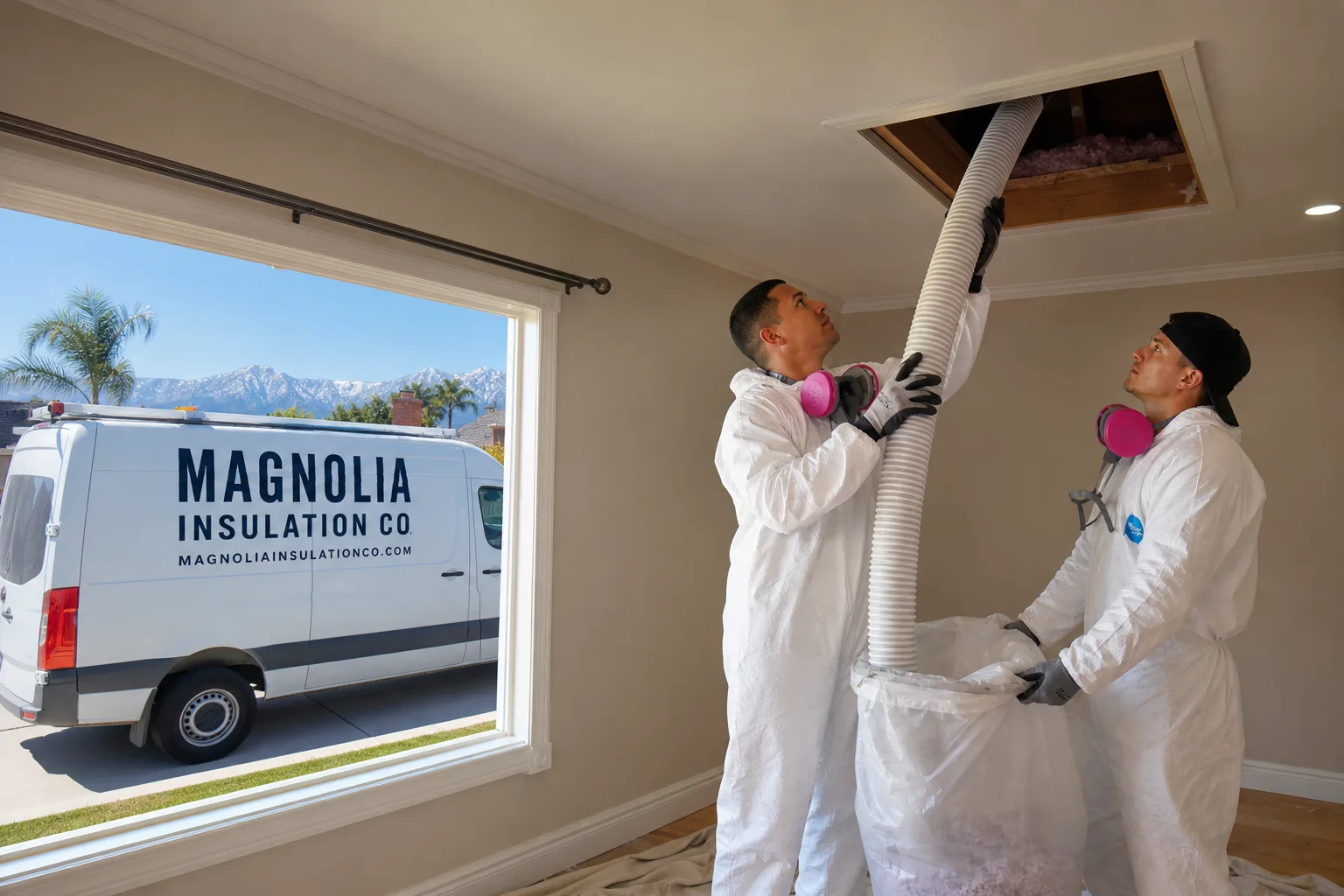
Response time to Whittier is typically same week for estimates, and for retrofit jobs we schedule crews around your availability, not the other way around. Homeowners tell us they appreciate that we show up when we say we will and that we leave the attic cleaner than we found it. Our Attic Insulation team has handled everything from Uptown bungalows to tract homes east of Whittier Boulevard, and we’re comfortable with tight access, shallow cavities, and older wiring situations that make other contractors walk away.
Insulation Contractors in Whittier
Insulation contractors in Whittier need to understand this city’s split personality: pre-war bungalows with true 2×4 framing and plaster walls on one side, and post-war tract homes with stucco exteriors and settled batt insulation on the other. That’s the reality of working in 90601 and 90610, and it’s why generic insulation advice doesn’t fly here. A full attic insulation retrofit in Whittier typically runs $2,800 to $6,500 depending on attic size, access difficulty, and the material chosen. Wall cavity work, when a homeowner wants to address the original empty bays, adds $3 to $6 per square foot of wall area.
Retrofit Expertise for Older Homes
Older Whittier homes frequently have no wall insulation at all. The framing is true-dimension 2×4, not the 3.5-inch nominal lumber used today, so standard R-13 batts don’t fit properly and get compressed, which kills their R-value. We dense-pack GreenFiber cellulose into those tight cavities instead, which performs well in shallow bays and fills around old plaster keys and lath irregularities. This is not a job for a crew that only does new construction.
Top-Ups and Replacements
In Whittier’s newer southern sections, the common scenario is 1960s or 1970s batt insulation that has settled to R-19 or less. We remove the failed material, air-seal the attic floor, and blow in Owens Corning loose fill to bring the attic to R-38 or R-49. Expect to pay $1,800 to $3,400 for a typical top-up and air-seal on a 1,200 to 1,800 square foot attic.
Attic Ventilation in Whittier
Attic ventilation in Whittier is not optional, and it’s not a side detail. Whittier sits in the inland valley where summer temperatures routinely hit 95 to 105 degrees. A poorly vented attic can reach 140 degrees or more, and that heat radiates down through the ceiling, forcing your AC to run every afternoon. Ventilation work in Whittier generally costs $600 to $1,800 depending on whether we’re adding baffles, installing ridge vents, or correcting intake issues at the eaves.
Baffles and Airflow Correction
Many older Whittier attics have zero baffles at the eaves, which means insulation blocks the soffit vents and the attic stops breathing. We install baffles before blowing in loose fill so air keeps moving from the soffits up to the ridge or gable vents. This is standard practice on our jobs, not an upsell.
Radiant Heat and AC Load
The dry, hot Whittier summer means radiant heat gain through the roof deck is the primary driver of attic temperature. Ventilation alone won’t solve an under-insulated attic, but it works with proper R-value to keep the ceiling plane closer to room temperature. If your upstairs is ten degrees hotter than your living room, the attic is almost always part of the problem.
Trusted Brands We Service in Whittier
We’re authorized installers for Owens Corning, Johns Manville, Knauf, Rockwool, CertainTeed, Icynene, Demilec, and GreenFiber. For Whittier attic jobs, the three brands we reach for most often are Owens Corning loose fill for attics, GreenFiber cellulose for wall cavities in older homes, and CertainTeed batts where batt makes sense. We stock local material for Whittier projects and can usually start within a week of the estimate. If a homeowner wants mineral wool for fire resistance or sound damping, Rockwool is in our lineup, and we’ll recommend it when the house calls for it.
Common Attic Insulation Problems We See in Whittier Homes
- Settled or missing insulation in pre-war bungalows. True 2×4 framing and shallow attic access leave little room for standard batts, and what was installed in the 1950s is often compressed to a fraction of its original R-value. The result is a hot upstairs and an AC that never cycles off.
- Knob-and-tube wiring in wall cavities. In Whittier’s 1920s to 1950s bungalows, original wiring hidden in plaster walls creates fire risk if insulation is blown in without an inspection. We flag this early and coordinate the inspection before any wall work begins.
- Radiant heat gain through unshaded roofs. Whittier’s 95 to 105 degree summer stretches bake attics that have no baffling and too little insulation. Homeowners see AC systems running continuously and energy bills that double between June and September.
- No attic baffling at the eaves. Many older Whittier homes lack even basic ventilation baffles, which means any new insulation blocks the soffit vents and makes the attic hotter than it was before the retrofit. We fix this on every job that needs it.
Pricing for Attic Insulation in Whittier, CA
A typical attic insulation replacement in Whittier runs $2,800 to $5,500 for a 1,200 to 2,000 square foot attic using blown-in loose fill. Top-ups with air sealing run $1,800 to $3,400. Wall cavity dense-packing for older bungalows adds $3 to $6 per square foot of wall area. Attic ventilation and baffle work runs $600 to $1,800 depending on the scope. Material choice moves the number: fiberglass loose fill is the most economical, GreenFiber cellulose costs slightly more, and spray foam for attic roofs is significantly higher and reserved for specific situations. Call (866) 464-1714 for an exact quote. Estimates are free, and we walk you through the number before you sign anything.
We Also Serve Cities Near Whittier
Whittier is our focus, but we regularly work in South Whittier, West Whittier-Los Nietos, East La Mirada, and Santa Fe Springs. If you’re in one of those communities, you’ll get the same material-agnostic recommendation and the same retrofit expertise. Learn more about Whittier coverage and surrounding areas directly from our team.
Serving Whittier, CA — Our Local Coverage Area
We’re based in the Whittier area and know this community well. Use the map below to see our service coverage — if you’re nearby, we can almost certainly help.
FAQs About Attic Insulation in Whittier
Yes, if your home was built before roughly 1955 and still has knob-and-tube wiring in the walls, you will likely need a wiring inspection before any wall cavity can be filled. Whittier’s original bungalows in the 90601 and 90602 areas frequently have this wiring, and blowing insulation around live knob-and-tube is a fire hazard and a code violation. For attic-only work where the wiring is in the ceiling or walls but not in the attic floor, the inspection may not be required, but we evaluate every job individually. Call (866) 464-1714 and we’ll tell you what your specific house needs.
Whittier’s inland valley climate means summer heat dominates the load calculation, so we prioritize ventilation and heat-reflective strategies alongside R-value. The dry, 95 to 105 degree stretches make attic ventilation and baffling as important as the insulation itself, because a non-vented attic can hit 140 degrees and radiate heat down into the living space. We often recommend a combination of air sealing, baffle installation, and blown-in loose fill at R-38 or higher for Whittier attics.
Yes, we work around tight attic access regularly, including the small scuttle holes common in Whittier’s pre-war bungalows. In severe cases where access is too small for safe work, we can install blown-in insulation through the access opening without needing to walk the entire attic. We’ll assess the access during the estimate and tell you exactly how we’ll approach your specific attic.
We use Owens Corning loose fill, GreenFiber dense-pack cellulose, and CertainTeed batts most frequently on Whittier jobs, with access to Icynene and Demilec spray foam for roof-deck applications. The brand we recommend depends on your attic type, framing depth, and access conditions, not on what we happen to have in stock. Call (866) 464-1714 to discuss which material fits your home.
A standard attic insulation replacement in Whittier takes four to six hours on site, and most jobs are completed in a single day. Wall cavity dense-packing adds time, typically one to two additional days depending on the number of rooms and access. We’ll give you a clear timeline at the estimate, and we stick to it.
Whittier’s Older Homes: What Actually Happens on a Retrofit
In Whittier’s pre-war bungalows, the wall cavities are true-dimension 2×4 framing, which means the studs are actually 2 inches by 4 inches, not the 1.5 by 3.5 inches of modern lumber. The interior walls are plaster on wood lath, and the original cavities usually have no insulation at all. When a homeowner asks us to improve comfort and energy performance, we first check whether knob-and-tube wiring is present in those walls. If it is, we pause the wall work and let the homeowner know a wiring inspection is required before any cavity can be filled. That’s a step newer tract homes in neighboring cities rarely face, and it’s a step many contractors skip entirely, leaving homeowners with a code violation and a fire hazard they don’t know about.
We recently completed an attic insulation retrofit on a 1940s bungalow near Uptown Whittier where the attic had settled batt insulation and no baffling. After confirming the knob-and-tube wiring in the walls, we dense-packed the 2×4 wall cavities with GreenFiber cellulose and blew in Owens Corning loose fill to bring the attic to R-38, adding baffles at the eaves to maintain ventilation. The homeowner told us the upstairs felt different within a week, and the AC stopped running past midnight.
What You Get When You Call Magnolia Insulation Co
You get a straight answer about what your attic needs and what it doesn’t. You get access to eight insulation brands with no incentive to sell one over another. You get a crew that respects your house, covers the work areas, and cleans up. And you get the phone number of a company that answers when you call. If you’re in Whittier and your attic insulation is settled, missing, or underperforming, call Glen Pacheco and the team at Magnolia Insulation Co at (866) 464-1714 for a free estimate. We’ll tell you what we would do, what it costs, and how long it takes. No pressure, no script.
Written by Glen Pacheco, Owner at Magnolia Insulation Co, serving Whittier and the surrounding communities.