Fast, Reliable Attic Insulation Across Walnut
Attic insulation in Walnut comes down to one thing: stopping foothill heat from cooking your house from the top down. We work in ZIP codes 91788, 91789, and 91795 every week, and we know exactly what these attics look like in July. Call (866) 464-1714 and we’ll have a crew at your door, usually within a day or two. This isn’t a coastal mild-climate insulation job. Walnut sits in the east San Gabriel Valley, where summer afternoons push past 95°F regularly and attic temperatures climb far higher. The insulation your home got in 1972 isn’t doing what you think it is.
Why Magnolia Insulation Co Is Walnut’s Preferred Attic Insulation Company
Our Walnut customers call us because their upstairs rooms won’t cool below 80°F in August, or because their AC runs from noon to midnight without stopping. We’ve been on enough hillside streets here to know the pattern: original R-11 batts, no radiant barrier, and an attic that feels like a kiln by 2 p.m. Homeowners in Walnut don’t need a sales pitch. They need someone who can look at a 1980s tract home off La Puente Road and tell them exactly why their insulation stopped performing. That’s what we do. Glen Pacheco built this company around a simple rule: recommend the right material for the specific home, not the material we happen to stock.
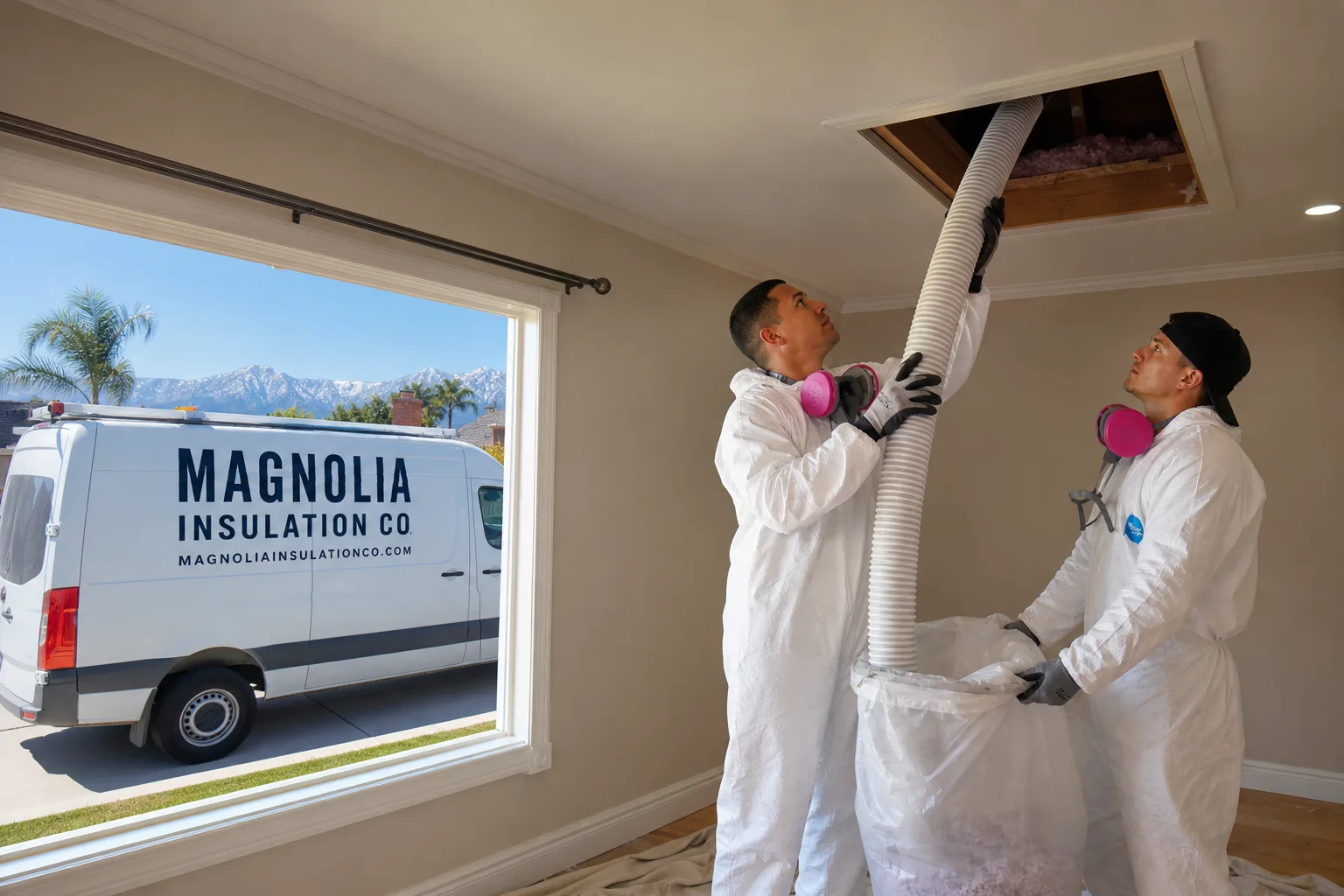
What Walnut homeowners tend to appreciate is that we show up with options, not a single-product agenda. We carry eight insulation brands, including Rockwool, CertainTeed, Icynene, and Demilec, so a 1960s ranch house gets a different recommendation than a 1990s hillside rebuild. Reviews from Walnut customers consistently mention the same thing: the upstairs finally cools down. We answer the phone, we show up when we say we will, and we don’t leave until the attic is air-sealed and insulation is where it belongs.
Attic Ventilation in Walnut
Attic Ventilation in Walnut is the difference between an attic that works with your AC and one that fights it all summer. When outside air hits 98°F, a poorly vented attic can sit at 140°F or higher. That superheated air radiates down through your ceiling insulation all night, which is why your upstairs feels hot even after the sun goes down. The fix involves making sure ridge vents, soffit vents, and gable vents are actually doing their job. On many Walnut homes, we find soffit vents painted over, ridge vents undersized, or homeowners who stored boxes directly on top of vent openings. That’s not a judgment, it’s just what decades of living in a house does.
Clearing and Upgrading Vent Paths
In foothill neighborhoods off Grand Avenue, blocked vents are the single most common contributor to 130°F+ attic temperatures we document. We clear the path, check that intake and exhaust are balanced, and add venting where the original builder cut corners. On a typical Walnut ranch, upgrading from two passive roof vents to a continuous ridge vent plus properly sized soffit intake runs $450 to $900 installed.
Venting for Foothill Heat Loads
Walnut’s hillside homes face a specific problem: south-facing and west-facing roof decks absorb direct sun all afternoon, and the heat has nowhere to go. Undersized or clogged vents trap that heat and bake your insulation, which loses R-value as it degrades. A ventilation correction on a hillside two-story usually lands between $700 and $1,400, depending on roof geometry. Call (866) 464-1714 for a straight answer on what your attic actually needs.
Radiant Barrier in Walnut
Radiant Barrier in Walnut is the single highest-impact upgrade for homes on hillside streets where the south roof deck gets hammered by the sun from 11 a.m. until 6 p.m. A radiant barrier is a foil facing installed on the underside of roof rafters that reflects radiant heat before it can reach your insulation. In a Walnut attic that hits 135°F in July, a properly installed radiant barrier can cut ceiling heat gain by 20 to 30 percent. That’s not marketing. That’s physics you can measure with an infrared thermometer.
New Foil for South-Facing Roof Decks
We install radiant barrier in Walnut attics where the original home never had it, which is most homes built before 2000. On a typical 1,800-square-foot single-story in 91789, retrofitting a radiant barrier to the rafter bays runs $1,200 to $2,200. The labor is almost entirely in the attic, which is why we do most of this work in the early morning hours during summer. Our crews are out of the attic before it gets dangerous.
Replacing Deteriorated Foil
Some Walnut homes from the 1990s had radiant barrier installed, but it’s torn, sagging, or detached from the rafters. We saw this on a hillside street off Lemon Avenue recently: foil was missing from an entire south-facing roof slope, and the attic hit 135°F by early afternoon. We replaced the barrier, air-sealed the top plates, and blew insulation to R-49. The homeowner told us the upstairs bonus room dropped from 88°F to 78°F on a 98°F afternoon. That’s the kind of result we aim for every time.
Trusted Brands We Service in Walnut
We are an authorized installer for eight nationally recognized insulation brands: Owens Corning, Johns Manville, Knauf, Rockwool, CertainTeed, Icynene, Demilec, and GreenFiber. In Walnut, that means we can match the material to your specific attic, whether it’s an open-cell Icynene spray foam for a hillside addition or Rockwool batts where you want fire resistance and sound damping. We keep local inventory staged for Walnut jobs, so turnaround on common materials is fast. Eight brands, one recommendation: the one that fits your home, your budget, and your performance goal. Glen Pacheco would rather lose a sale than sell you the wrong material for a foothill attic.
Common Attic Insulation Problems We See in Walnut Homes
- Compressed, heat-damaged R-11 batts. Most Walnut homes built between 1960 and 1990 got R-11 fiberglass in the attic. After 30 or 40 summers of 130°F+ attic temperatures, those batts are slumped, compressed, and effectively useless.
- Missing or deteriorated radiant barrier. Even in homes where builders bothered to install foil, it’s often torn, sagging, or gone entirely from south-facing slopes. Without it, radiant heat pours straight into your insulation and then into your living space.
- Blocked or undersized attic vents. Boxes, holiday decorations, and original undersized vents choke airflow in Walnut attics everywhere we look. Superheated air gets trapped and accelerates insulation degradation.
- Uninsulated additions and garage conversions. Walnut has a lot of homes with converted garages or added family rooms. Builders often skipped insulation entirely in these spaces, which is why they’re the hottest room in the house every summer.
Pricing for Attic Insulation in Walnut, CA
A typical attic insulation top-up in Walnut runs $1,100 to $2,400 for a standard single-story home, depending on existing R-value and attic accessibility. A full removal and replacement of failed insulation lands between $2,800 and $5,500 for most Walnut homes, with hillside two-story properties on the higher end. Attic baffles and ventilation prep typically add $350 to $800. Blown-in cellulose from GreenFiber and blown-in fiberglass from Owens Corning are priced comparably per installed R-value. Every job gets an attic inspection and a written line-item estimate before we start. Call (866) 464-1714 and we’ll come out and give you real numbers for your specific roof, not a phone quote based on square footage alone.
We Also Serve Cities Near Walnut
Our crews work throughout the east San Gabriel Valley, including South San Jose Hills, Rowland Heights, West Covina, and Pomona. If you’re in Attic Insulation in Walnut territory or just over the city line, the same team, same pricing, and same brand selection applies.
Serving Walnut, CA — Our Local Coverage Area
We’re based in the Walnut area and know this community well. Use the map below to see our service coverage — if you’re nearby, we can almost certainly help.
FAQs About Attic Insulation in Walnut
Walnut sits farther inland than coastal cities, and neighborhoods near the San Gabriel foothills absorb direct afternoon sun on south- and west-facing roof decks. Attic temperatures above 130°F are routine in July and August, which is far hotter than you’d see in a beach community.
For Walnut’s inland heat, we recommend R-38 as the minimum for existing homes, with R-49 ideal for hillside homes with large south-facing roof exposures. The goal is heat rejection and reducing AC load, not trapping warmth in winter.
Yes. Walnut’s dominant problem is radiant heat gain from direct sun, and a radiant barrier attacks exactly that problem before heat ever reaches your insulation. It’s one of the most cost-effective upgrades for a foothill attic.
If your upstairs rooms run 10°F warmer than downstairs on a 95°F day, or your AC runs constantly from early afternoon into the night, your attic insulation is almost certainly underperforming. The fastest way to know is a free attic inspection. Call (866) 464-1714 and we’ll tell you exactly what’s up there.
We install Owens Corning, Johns Manville, Knauf, Rockwool, CertainTeed, Icynene, Demilec, and GreenFiber. The brand we recommend for your Walnut home depends on your attic structure, budget, and performance goals, not on what we happen to have on the truck.
If your Walnut attic is hot, under-insulated, or you’re just tired of paying to cool a house that won’t stay cool, call (866) 464-1714 for a free estimate. We’ll inspect the attic, show you what’s actually going on up there, and give you a written recommendation with real numbers. No pressure, no generic pitch. Just building-science basics in plain English, from a team that knows Walnut attics better than anyone.
Written by Glen Pacheco, Owner at Magnolia Insulation Co, serving Walnut and the east San Gabriel Valley.