Fast, Reliable Attic Insulation Across South San Jose Hills
Attic insulation in South San Jose Hills usually costs between $1,800 and $6,200 depending on whether we’re topping up existing material, removing failed batts, or starting fresh with a radiant barrier and R-38. Most jobs in the 91792 ZIP take one to two days from start to finish. If your attic is baking in the afternoon sun and your upstairs rooms never quite cool down, the fix is usually more specific than just adding fiberglass. We know these hillside tracts and how they behave. Call (866) 464-1714 for a free estimate, and we’ll come out to South San Jose Hills, walk the attic with you, and tell you exactly what’s going on up there.
Why Magnolia Insulation Co Is South San Jose Hills’s Preferred Attic Insulation Company
We’ve spent enough time in the attics of South San Jose Hills to recognize the patterns. The 1960s and 70s ranch homes off Fairgrove Avenue and along the hillside streets share the same original construction: 2×4 rafter bays, thin ceiling cavities, and batts that have been cooked by the sun for fifty years. Homeowners here don’t need a sales pitch. They need someone who can look at a collapsed R-7 batt and explain why the upstairs bedroom runs ten degrees hotter than the kitchen.
Our crews know the 91792 housing stock. We’ve air-sealed top plates on wood-frame homes that leak conditioned air straight into the attic, and we’ve stapled radiant barriers to the undersides of roof rafters on exposed west-facing slopes. That’s local knowledge you can’t get from a national chain. When you call Magnolia Insulation Co, you get a team that’s seen your exact house before. We serve South San Jose Hills with same-week scheduling in most cases, and we’ll give you a straight answer about what’s needed and what isn’t. The recommendation always fits the home, not our inventory.
Attic Mold Removal in South San Jose Hills
Attic mold removal in South San Jose Hills typically costs $1,200 to $3,800 depending on the size of the affected area and whether the mold has reached the roof sheathing. Homes in the 91792 ZIP are prone to attic mold because the same 1960s – 70s construction that lacks proper insulation also lacks proper ventilation. Warm air from the living space rises through unsealed top plates, hits the cool underside of the roof at night, and condenses. That moisture soaks into the framing and the insulation, and once mold takes hold, it spreads through the fiberglass and into the wood. Before any new insulation goes in, the mold has to come out.
Mold Removal Before New Insulation
You can’t blow fresh insulation over moldy batts and expect the problem to disappear. The mold is a symptom of moisture, and the moisture is a symptom of air movement. We remove the contaminated material, treat the affected wood, and correct the ventilation and air-sealing issues that caused the problem. Only then does new insulation make sense.
Ventilation Problems That Cause Mold
Many South San Jose Hills attics were built with gable vents only, no soffit vents, no ridge vent. That’s a stagnant attic. Add Santa Ana winds forcing dust and debris through the gable vents, and you get a humid, dirty space that grows mold easily. We address the ventilation before recommending an R-value.
Attic Insulation Removal in South San Jose Hills
Attic insulation removal in South San Jose Hills typically runs $1.50 to $3.00 per square foot of attic floor space, so a 1,200-square-foot attic would land between $1,800 and $3,600. The original R-7 and R-11 batts installed in these 91792 tract homes have long since compacted, slumped, and collected decades of dust from Santa Ana winds. In many cases, the paper facing has flaked off from repeated heat exposure. You don’t want to blow new material over that mess. The old stuff has to come out so the new insulation can actually perform.
When Removal Is Necessary
If the existing batts are collapsed, moldy, pest-damaged, or so thin that they’ve stopped insulating entirely, removal is the right call. We see this constantly in South San Jose Hills homes where the original insulation was minimal from the start. Air-sealing happens after removal and before new material goes in, so the ceiling cavity is sealed properly for the first time since the house was built.
What Removal Involves
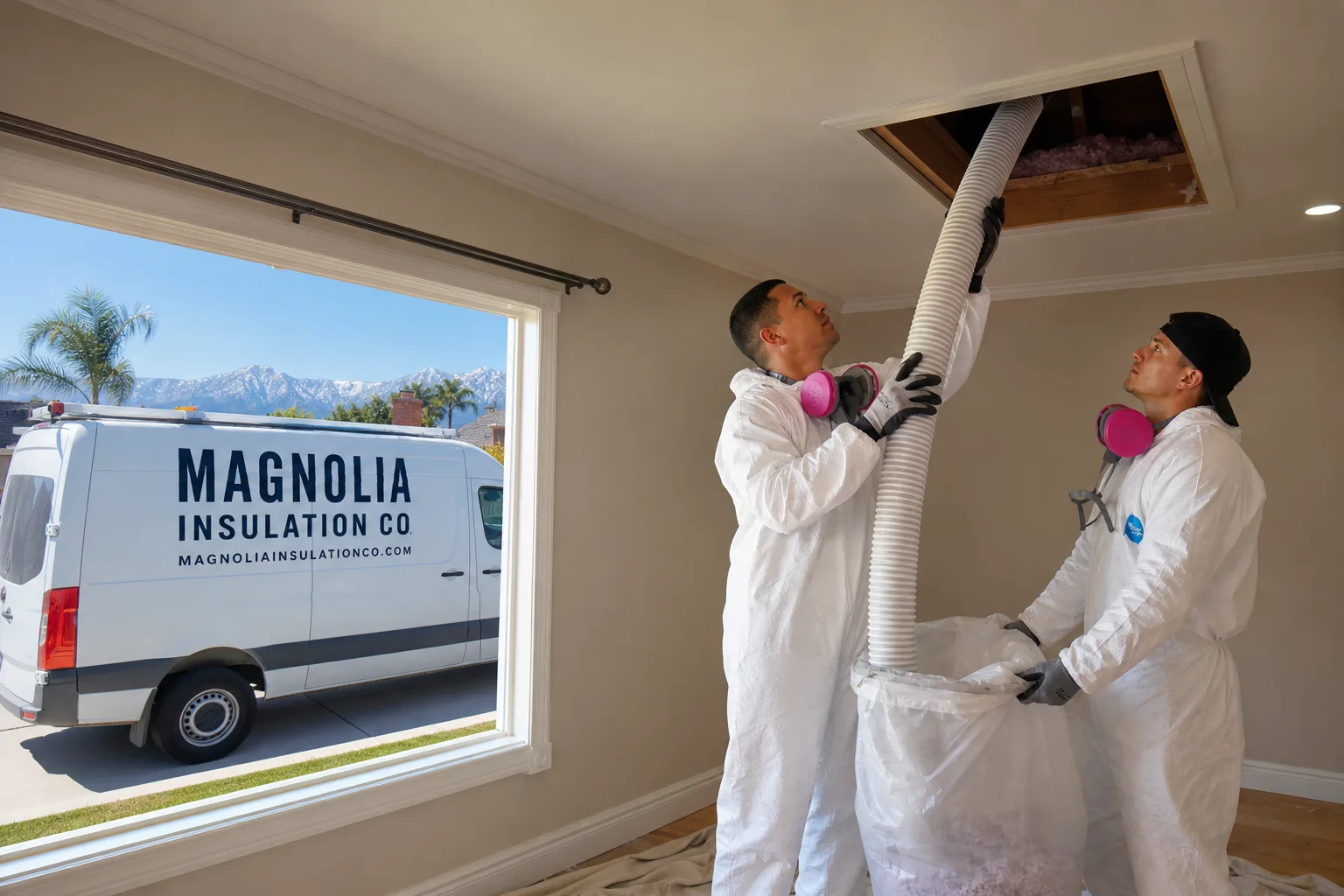
We use commercial vacuum equipment to extract the old material, bag it, and haul it away. Then we inspect the top plates, can lights, and plumbing penetrations for air leaks. The difference after air-sealing alone is often noticeable within a day. From there, we can blow in new fiberglass or install batts, depending on the attic layout and your budget.
Trusted Brands We Service in South San Jose Hills
Magnolia Insulation Co carries eight of the industry’s most respected insulation brands, so we’re never stuck recommending one product for every home. In South San Jose Hills, we often reach for Owens Corning fiberglass for blown-in R-38 attic coverage, Icynene or Demilec spray foam when air-sealing and thermal performance both matter, and GreenFiber cellulose for homeowners who want a high-recycled-content option. That’s the whole point: the right material for your specific attic, not whatever we happen to have in the truck. Our crews know how each material behaves in the heat of a hillside attic, and we’ll explain the tradeoffs in plain English.
Common Attic Insulation Problems We See in South San Jose Hills Homes
- Collapsed original batts from the 1960s and 70s. The R-7 and R-11 fiberglass put in during construction has compacted against the eaves, leaving the center of the ceiling with almost no thermal resistance. This is the single most common issue in 91792 tract homes.
- Sun-baked roof slopes on hillside lots. Unshaded west and south slopes regularly hit 150°F plus on summer afternoons, which degrades kraft-faced batts until the paper facing flakes off. The insulation essentially cooks in place.
- Santa Ana wind dust infiltration. Hot winds force fine dust through gable vents and unsealed top plates, clogging older batts and reducing whatever R-value they still had. Thin-wall wood-frame construction makes this worse.
- Uneven room temperatures upstairs. Homeowners tell us the upstairs bedrooms run eight to ten degrees hotter than the downstairs. That’s a direct symptom of attic heat radiating through a poorly insulated ceiling plane.
Pricing for Attic Insulation in South San Jose Hills, CA
A straightforward blow-in insulation top-up in South San Jose Hills runs $1,800 to $3,200 for a typical 1,000 to 1,500-square-foot attic. Full removal and replacement with R-38 fiberglass and a radiant barrier lands between $4,000 and $6,200. Attic mold removal adds $1,200 to $3,800 depending on containment and treatment needs. What drives the price: the attic’s square footage, whether the old material has to come out, whether air-sealing is included, and whether a radiant barrier makes sense for your roof slope. Free estimates mean you’ll know the number before you commit. Call (866) 464-1714 and we’ll come out to South San Jose Hills to price your attic properly.
We Also Serve Cities Near South San Jose Hills
Magnolia Insulation Co works throughout the eastern San Gabriel Valley. Beyond South San Jose Hills, we regularly handle Attic Insulation projects in Valinda, Walnut, West Covina, and Rowland Heights. If you’re in one of those cities and dealing with the same older tract construction, the same hillside heat, and the same thin original insulation, we can help. Our crews know the entire corridor, and scheduling across these neighborhoods is straightforward. See our Attic Insulation in South San Jose Hills page for full local details.
Serving South San Jose Hills, CA — Our Local Coverage Area
We’re based in the South San Jose Hills area and know this community well. Use the map below to see our service coverage — if you’re nearby, we can almost certainly help.
FAQs About Attic Insulation in South San Jose Hills
If the original batts in your South San Jose Hills home are still intact and dry, we can blow new insulation over them in many cases. But in most 1972-era 91792 homes we inspect, the original R-7 batts have compacted or collected enough dust and pest debris that a clean removal is the better call. Blowing over failed material hides the problem instead of fixing it. We’ll tell you what we’d do in your own attic after we look at it. Call (866) 464-1714 for a free inspection.
Radiant barriers block radiant heat gain, which is the dominant heat source in a hillside attic with an exposed west or south slope. Fiberglass slows conductive heat transfer but does little against the direct solar radiation that pushes attic temperatures past 150°F. On the sun-baked lots along Fairgrove Avenue and similar hillside streets, a radiant barrier stapled to the rafter undersides plus R-38 blown fiberglass delivers a measurable temperature drop that R-38 alone won’t reach. Call (866) 464-1714 and we’ll explain how it works for your roof orientation.
Yes, attic mold is common in 91792 homes because the original 1960s – 70s attics often lack proper ventilation, and warm, moist air from the living space condenses on the roof sheathing at night. We handle it by removing contaminated insulation, treating the wood, correcting the ventilation deficiencies, and air-sealing the top plates before any new material is installed. Mold left in place under new insulation continues to grow. For a mold assessment in South San Jose Hills, call (866) 464-1714.
Santa Ana winds push hot air and fine dust through the gable vents and any unsealed openings in the top plates, which clogs older batts and forces the attic temperature up. The dust settles into fiberglass over time and reduces its effective R-value. Air-sealing the top plates and ensuring the attic has balanced ventilation are the two fixes we recommend most often in South San Jose Hills homes exposed to these winds. For a free attic assessment, call (866) 464-1714.
We recommend R-38 as the minimum for most attics in South San Jose Hills, with a radiant barrier on exposed slopes. The inland foothill climate swings from summer days above 100°F to winter nights near freezing, so the insulation has to resist both solar gain and nighttime heat loss. Many 91792 homes sit at R-7 to R-11 right now, which explains the hot upstairs rooms in July and the cold mornings in December. Call (866) 464-1714 and we’ll tell you exactly what your attic needs.
On a 1971 ranch on the hillside above Fairgrove Avenue, our crew found the original 2×4 rafters packed with collapsed R-7 batts that had been baked by an unshaded south slope for decades. The homeowner’s upstairs rooms were running eight to ten degrees hotter than the downstairs. We pulled the failed batts, air-sealed the top plates, stapled a radiant barrier to the underside of the rafters, and blew in Owens Corning R-38 fiberglass to bring the attic under control.
If your South San Jose Hills attic has never been properly assessed, the problem isn’t going to fix itself. The hot afternoons, the cold winter nights, and the Santa Ana winds aren’t getting milder. Call Magnolia Insulation Co at (866) 464-1714 for a free estimate. We’ll inspect your attic, explain what’s going on up there, and give you a straight recommendation with a straight price. No pressure, no upselling, just building-science basics in plain English.
Written by Glen Pacheco, Owner at Magnolia Insulation Co, serving South San Jose Hills and the eastern San Gabriel Valley with attic insulation, spray foam, and blown-in services.