Fast, Reliable Attic Insulation Across Highgrove
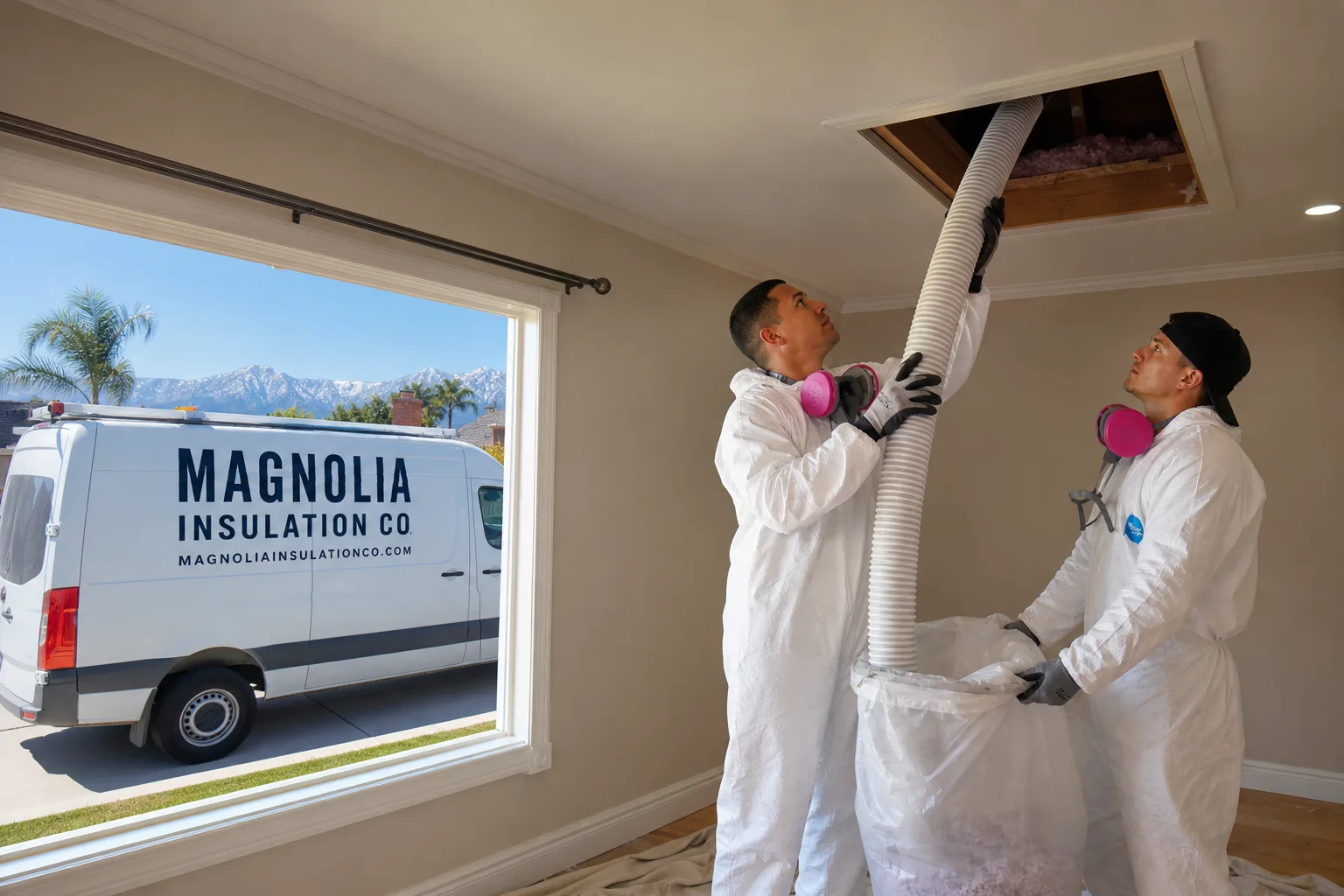
Attic insulation in Highgrove, CA typically costs $1,800 – $5,200 for a full installation on a standard 1,200 – 1,600 square foot home, with top-ups running $700 – $1,400 and radiant barrier add-ons between $1,100 – $2,800. Most jobs are completed in one day. The intense inland heat that hits Highgrove every summer makes attic insulation the single highest-impact upgrade a homeowner here can make, but the older housing stock brings a complication most companies miss: unvented attics that cook insulation from the inside out. Our team at Magnolia Insulation Co works throughout the 92313 zip code and understands exactly what these legacy homes need. Call us at (866) 464-1714 if your attic feels like an oven by noon.
We’re familiar with every block from Highgrove Avenue down to the Colton border, and we know the citrus-era bungalows that dominate this area weren’t built for 105°F summers. That’s why we approach every Highgrove job as a ventilation-first project and only then add the Attic Insulation that will actually hold up. Glen Pacheco, who leads our install teams, grew up in the Inland Empire and has spent years diagnosing why older homes here stay hot even after insulation gets added. The answer, nine times out of ten, is airflow.
Key Takeaways:
- Highgrove’s citrus-era homes frequently have unvented attics that require ventilation work before insulation can perform as designed.
- Full attic insulation replacement in Highgrove runs $1,800 – $5,200, with the older bungalows usually on the higher end due to air-sealing prep work.
- Radiant barrier is one of the best investments in this climate, since it blocks the specific type of heat that inland sun generates.
- Our team is based nearby in Rancho Cucamonga and reaches most Highgrove addresses within 45 to 60 minutes for estimates and same-week installs.
- Call (866) 464-1714 for an exact quote. Free estimates, no pushy sales pitch.
Why Magnolia Insulation Co Is Highgrove’s Preferred Attic Insulation Company
Highgrove homeowners don’t need another generic contractor. They need a crew that understands what happens inside an unvented attic in August when the shingles hit 140°F. That’s the house we wrote the playbook for. We’ve crawled through enough attics near Center Street, Barton Road, and the older blocks around La Crosse Avenue to know exactly what we’ll find before the ladder goes up: minimal or zero original insulation, disconnected ductwork, and soffits that never got a single vent hole.
Glen Pacheco has structured Magnolia Insulation Co around a simple principle: recommend the material that fits the building, not the material sitting in our warehouse. We carry eight nationally recognized brands including Owens Corning, Johns Manville, Knauf, Rockwool, CertainTeed, Icynene, Demilec, and GreenFiber, plus Reflectix service in Highgrove. That’s a real difference here. A 1950s bungalow with no cavity insulation needs a different approach than a 2015 infill home with code-minimum fiberglass. We have both answers under one roof.
Response time matters in this climate. When a homeowner realizes their AC is running constantly and the upstairs is still 85°F, they don’t want to wait three weeks for a quote. Our Rancho Cucamonga base puts us 20 minutes from most Highgrove neighborhoods. We return calls the same day, schedule free estimates within a few days, and can typically start installation within the week.
Attic Ventilation in Highgrove
Attic Ventilation in Highgrove is not optional, and we’ll say that to any homeowner here even if they’d rather skip it and just add insulation. The math is simple: an unvented attic on a 105°F day in the 92313 zip code can hit 160°F. That heat radiates down through your ceiling, and any insulation you install is fighting a losing battle from day one. When we add ventilation first, the attic drops to within 10 degrees of the outside air, and then the insulation actually insulates.
A full ventilation upgrade in Highgrove, meaning ridge vents, soffit vents, and baffles, typically runs $900 – $2,200 depending on the roofline and attic footprint. Older wood-shingle or composition roofs on citrus-era homes sometimes need additional prep work, which pushes the estimate higher. We show you exactly what’s needed and what isn’t.
Why ventilation comes first in Highgrove’s older homes
Most of the pre-1980 bungalows in this area were built with gable-end vents or nothing at all. The original builders assumed the attic would just be hot. That thinking died about the time AC units became standard. Now we walk into these homes and find the attic is a heat sink that never stops radiating downward, even at midnight. Adding insulation alone just wraps that heat in a blanket and keeps it there longer. The fix is airflow: inlet air at the soffits, outlet air at the ridge. It’s a one-day job in most cases.
Signs your Highgrove attic needs ventilation work
If your ceiling feels warm to the touch at 9 p.m., that’s not normal wear and tear. That’s stored heat. If you can smell a stale, baked-dust odor when the attic access is opened, that’s trapped air that should have exited through a ridge vent. Highgrove’s low humidity is actually an advantage here, because we don’t fight mold and moisture the way coastal installers do, but the heat problem is more severe than almost anywhere else in the region.
Radiant Barrier in Highgrove
Radiant Barrier in Highgrove is the single most effective upgrade for blocking the specific type of heat this area generates. The inland sun beats down on your roof deck, and that heat transfers as infrared radiation into the attic space. A radiant barrier is a reflective foil layer that bounces most of that radiation back outside before it ever reaches your insulation or living space. In a Highgrove summer, a properly installed radiant barrier can drop attic temperatures by 15 to 30 degrees on hot afternoons.
Installing radiant barrier in a typical Highgrove attic runs $1,100 – $2,800. The spread depends on attic size, whether the roof pitch allows for stapling to the rafters or if we’re laying it over the floor joists, and how much prep work the existing insulation requires.
How a radiant barrier differs from insulation
Insulation slows heat transfer through conduction. A radiant barrier reflects heat transfer through radiation. These are different jobs, and in Highgrove’s climate, you need both. Insulation alone won’t stop the roof deck from radiating heat downward. A radiant barrier alone won’t slow the heat that eventually gets through. Together, they’re the best combination we recommend for staying comfortable and cutting cooling costs in the 92313 area.
Radiant barrier for citrus-era homes
The older Highgrove bungalows benefit most dramatically from radiant barrier. These homes often have low-slope roofs or small attic spaces where conventional insulation options are limited. A foil layer stapled to the undersides of the rafters takes up no floor space and doesn’t interfere with existing framing. Combined with proper ventilation, it’s often the difference between an upstairs that stays livable in August and one that feels like a sauna.
Trusted Brands We Service in Highgrove
We install and service insulation from eight established manufacturers, so the recommendation always comes from what your specific home needs. For Highgrove’s hot, dry climate, we frequently steer homeowners toward CertainTeed fiberglass for dense coverage in standard attic cavities, GreenFiber blown-in cellulose for older attics with irregular joist spacing and air gaps, and Icynene or Demilec spray foam when a homeowner wants to turn the attic into a sealed, conditioned space. We keep common materials in stock for quick turnaround on Highgrove jobs and can order specialty products within a few days. No brand loyalty here, just whatever performs best for your house.
Common Attic Insulation Problems We See in Highgrove Homes
- Insulation baked into uselessness. Unvented attics in Highgrove’s older citrus-era homes trap heat day after day, which degrades fiberglass and cellulose over time. We see this constantly on homes that had insulation added in the 1970s or 1980s without any ventilation work.
- Code-minimum insulation in newer infill builds. Many Highgrove homes built in the last 15 to 20 years have R-30 or R-38 in the attic because that’s what code required. It meets the letter of the law and fails completely in a 105°F August. These homes need a top-up to R-49 or R-60.
- Thermal bridging in legacy walls. Older bungalows have uninsulated wood-framed walls and single-pane windows. You can add all the attic insulation you want, but heat still enters through the walls and windows. We’re honest about this: attic insulation is the highest-impact upgrade, but it won’t fully solve comfort issues if the walls are bare.
- Disconnected or torn ductwork in the attic. Older homes in Highgrove often have original metal or flex ducts running through a 150°F attic and leaking cooled air into dead space. We don’t typically handle duct replacement, but we’ll tell you if we see it during the insulation estimate, because adding R-60 won’t matter if your ducts are bleeding air.
We recently worked on a 1950s citrus-belt bungalow near the intersection of Center Street and Highgrove Avenue where the attic had zero insulation and unvented soffits. After installing proper ridge and soffit ventilation, we blew in Owens Corning Fiberglas to R-49 and added a radiant barrier, dropping the attic temperature by over 30°F on a 105°F day. That’s the kind of measurable result we chase on every Highgrove job.
Pricing for Attic Insulation in Highgrove, CA
For attic insulation in Highgrove, CA, here’s what homeowners can expect as of 2026:
- Attic insulation top-up (add R-19 to R-30 over existing): $700 – $1,400 for a 1,500 square foot attic.
- Full attic insulation replacement (remove old, air seal, install fresh): $1,800 – $4,200 depending on attic size, access difficulty, and material choice.
- Blown-in cellulose or fiberglass for a bare attic: $1,600 – $3,800. GreenFiber cellulose runs slightly higher than fiberglass but offers better sound damping and recycled content.
- Spray foam attic (open-cell or closed-cell): $3,500 – $8,000. This includes sealing the attic envelope and is more involved than blown-in work.
- Radiant barrier installation: $1,100 – $2,800.
- Attic ventilation correction (soffit, ridge, baffles): $900 – $2,200.
What moves your quote up or down: attic accessibility, how much old insulation needs removal, whether the roof deck needs repairs, and whether air sealing is needed first. Glen Pacheco reviews every estimate personally before it goes out. Call (866) 464-1714 for a free estimate, and we’ll give you a range on the spot and a firm number after we see the attic.
We Also Serve Cities Near Highgrove
Our service area extends beyond Attic Insulation in Highgrove into the surrounding communities. We regularly run crews to Grand Terrace, Colton, Loma Linda, and Rubidoux, so no matter which side of the 92313 zip you’re on, we can reach you fast. If you’re near the Colton border or up toward Grand Terrace, you’re still well within our normal response area.
Serving Highgrove, CA — Our Local Coverage Area
We’re based in the Highgrove area and know this community well. Use the map below to see our service coverage — if you’re nearby, we can almost certainly help.
FAQs About Attic Insulation in Highgrove
Your attic gets hot because Highgrove’s inland sun heats the roof deck to 140°F or more, and if the attic isn’t properly ventilated, that heat has nowhere to go. Insulation slows heat transfer into your living space, but it can’t stop the attic itself from getting hot. The fix is adding proper ventilation first, then adding or upgrading insulation. If you’re in the 92313 area and want to check whether your attic ventilation is adequate, call (866) 464-1714 for a free assessment.
Yes, in almost every case. The older homes have low-slope and sometimes cramped attics where a radiant barrier stapled to the rafters is one of the few effective upgrades available. A radiant barrier reflects infrared radiation from the roof deck before it reaches your insulation, which matters far more in Highgrove’s 100°F+ summers than in milder coastal communities. Expect to pay $1,100 – $2,800 for a typical install. Call (866) 464-1714 for an exact quote.
You can, but you shouldn’t. Adding insulation to an unvented attic in Highgrove traps heat and accelerates the degradation of the insulation you just paid for. The attic radiates stored heat downward late into the night, which means your rooms stay hot even after the outside air cools. Ventilation needs to come first. A ventilation correction runs $900 – $2,200 and makes every subsequent insulation dollar actually work.
For Highgrove’s hot inland climate, we recommend R-49 to R-60 in the attic. The Department of Energy’s climate zone map puts this area in Zone 3, which calls for R-38 minimum, but that assumes a properly ventilated attic and average heat. Highgrove’s summer extremes push the practical recommendation higher. We typically recommend R-49 blown-in fiberglass or cellulose, plus a radiant barrier if the roof faces significant direct sun.
Low humidity is one of Highgrove’s few structural advantages. In humid climates, fiberglass and cellulose can absorb moisture and lose R-value, and mold becomes a concern. Here, that’s rarely an issue. This means we can safely recommend any of our eight brands, including GreenFiber cellulose and Icynene or Demilec spray foam, without worrying about moisture degradation. The bigger concern is heat, not dampness, and that changes the priority order: ventilation first, radiant barrier second, insulation third.
Get Your Free Highgrove Attic Insulation Estimate
If your Highgrove home has a hot attic, a stuffy second floor, or an AC that runs all day and still can’t keep up, the problem is probably above your ceiling. We’ll come out, inspect the attic, and tell you exactly what’s going on and what it costs to fix. No obligation, no pressure. Call (866) 464-1714 and ask for Glen. Free estimates, licensed and insured installers, and honest recommendations based on your specific house, not our inventory.
Written by Glen Pacheco, Owner at Magnolia Insulation Co, serving Highgrove and the Inland Empire.